
Anyone who has worked closely with field crops knows one simple truth: what happens early decides everything later. The first few weeks after emergence determine whether a crop builds a strong foundation—or spends the rest of the season trying to catch up.
During this early growth window, crops are building leaf area, activating photosynthesis, and establishing nutrient transport pathways. While nitrogen and phosphorus often get the spotlight, magnesium, manganese, and zinc quietly play some of the most critical roles. When these micronutrients are missing or poorly available, early physiological disorders appear long before visual deficiency symptoms become obvious.
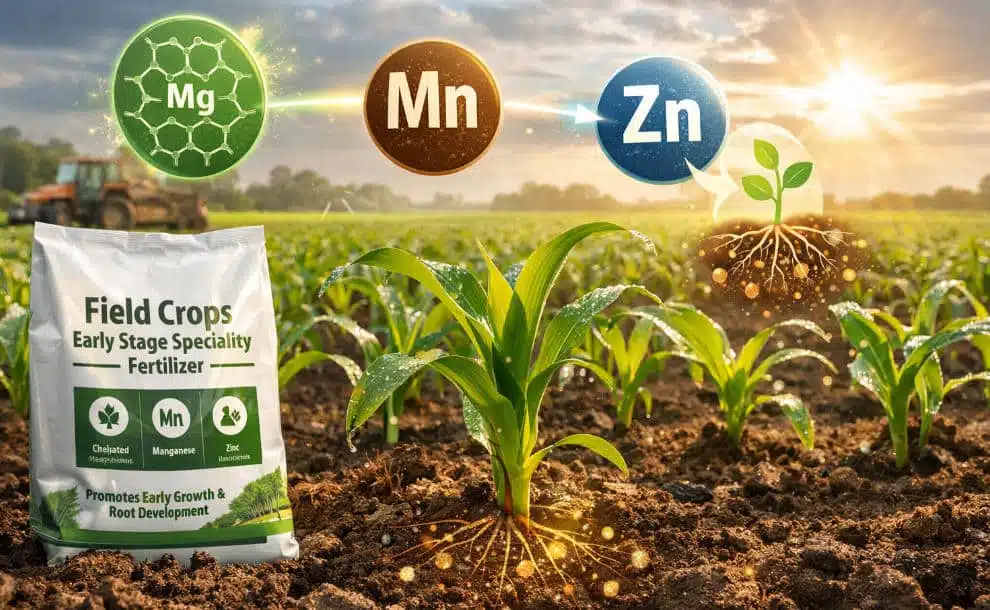
This is exactly why targeted solutions like Field Crops Early Stage Specialty Fertilizer are designed specifically for this stage of development: to support photosynthesis, nutrient movement, and balanced early growth when crops are most sensitive.
Magnesium: The Engine Behind Early Photosynthesis
Magnesium is not just another secondary nutrient—it sits at the very heart of photosynthesis. Every chlorophyll molecule depends on magnesium to capture light energy. When magnesium availability is limited during early growth, photosynthesis slows, even if leaves appear green at first glance.
Beyond chlorophyll formation, magnesium plays a key role in nutrient transport within the plant. It helps move sugars produced in the leaves down to the roots and growing points. If magnesium is insufficient, carbohydrates accumulate in leaves while roots remain underdeveloped. The result is weak early root systems and uneven crop establishment.
In practical field conditions, magnesium deficiency is especially common in acidic soils, sandy soils, or during cool early-season weather. Using an early stage specialty fertilizer with chelated magnesium helps ensure consistent uptake, allowing crops to build photosynthetic capacity right from the start.
Manganese: Supporting Photosynthesis at the Enzyme Level
Manganese often goes unnoticed until crops begin showing uneven chlorosis or slow early growth. Its importance lies in what it does behind the scenes. Manganese activates multiple enzymes involved in photosynthesis, particularly those responsible for splitting water molecules during the light reactions.
In early crop development, manganese also supports nitrogen metabolism and protein synthesis. Without adequate manganese, plants struggle to efficiently convert nutrients into usable growth components. This can lead to delayed leaf expansion and reduced early vigor—problems that are difficult to correct later in the season.
A well-formulated field crops early stage specialty fertilizer supplies manganese in a chelated form, improving availability in soils where manganese may be present but locked up. This ensures that young crops can maintain steady photosynthetic activity and balanced nutrient utilization during early vegetative growth.
Zinc: Regulating Growth and Nutrient Efficiency
Zinc plays a different but equally important role during early growth stages. It is directly involved in enzyme activation and hormone regulation, especially the production of auxins that control cell division and elongation.
When zinc is deficient, crops often show stunted growth, shortened internodes, and poor root development. Even mild zinc shortages can disrupt nutrient transport efficiency, reducing the plant’s ability to move phosphorus, nitrogen, and sugars to active growth zones.
Early-season zinc nutrition is especially critical because young plants have limited root systems and reduced ability to access soil-bound zinc. Including chelated zinc in an early growth nutrition program helps maintain hormonal balance and supports uniform crop establishment.
Why Early-Stage Micronutrient Balance Matters
Magnesium, manganese, and zinc do not work in isolation. Their functions overlap and reinforce one another:
- Magnesium drives photosynthesis and carbohydrate movement
- Manganese supports enzyme systems that keep photosynthesis efficient
- Zinc regulates growth hormones and nutrient transport pathways
When these micronutrients are supplied in balanced ratios during early development, crops experience smoother early growth, stronger root systems, and better tolerance to environmental stress.
Products like Field Crops Early Stage Specialty Fertilizer are formulated with this synergy in mind. By combining chelated micronutrients with amino-acid carriers, the fertilizer supports faster absorption, improved nutrient mobility, and more consistent early performance across different soil conditions.
A Practical Approach to Early Crop Nutrition
Early crop nutrition is not about pushing aggressive growth—it’s about removing hidden limitations. When magnesium, manganese, and zinc are adequately supplied from the beginning, crops can focus energy on building structure, expanding leaf area, and establishing efficient nutrient transport systems.
Addressing these micronutrient needs early helps prevent common early-stage issues such as slow emergence, pale foliage, uneven stands, and delayed root development. More importantly, it creates a physiological advantage that carries through the entire growing season.


