
Durian trees are known for their high nutrient demand and long production cycle. From young tree establishment to flowering, fruit setting, and harvest, proper nutrient management plays a decisive role in tree health, yield stability, and fruit quality. An effective durian tree nutrient management strategy is not just about applying fertilizer—it is about applying the right durian fertilizer at the right time.
This article explains how to manage nutrients throughout the durian growth cycle and how different types of Durian Fertilizer support sustainable and profitable production.
Understanding Nutrient Requirements of Durian Trees
Durian trees require both macro- and micronutrients in relatively high quantities due to their vigorous vegetative growth and heavy fruit load.
Key nutrients include:
- Nitrogen (N): Supports leaf growth and canopy development
- Phosphorus (P): Essential for root growth, flowering, and fruit initiation
- Potassium (K): Critical for fruit enlargement, flavor, and shelf life
- Calcium (Ca) & Magnesium (Mg): Improve fruit structure and reduce physiological disorders
- Micronutrients (B, Zn, Fe): Support flowering, pollination, and enzyme activity
Balanced durian fertilizer programs aim to meet these needs while avoiding excessive nitrogen, which can lead to excessive vegetative growth and poor fruiting.
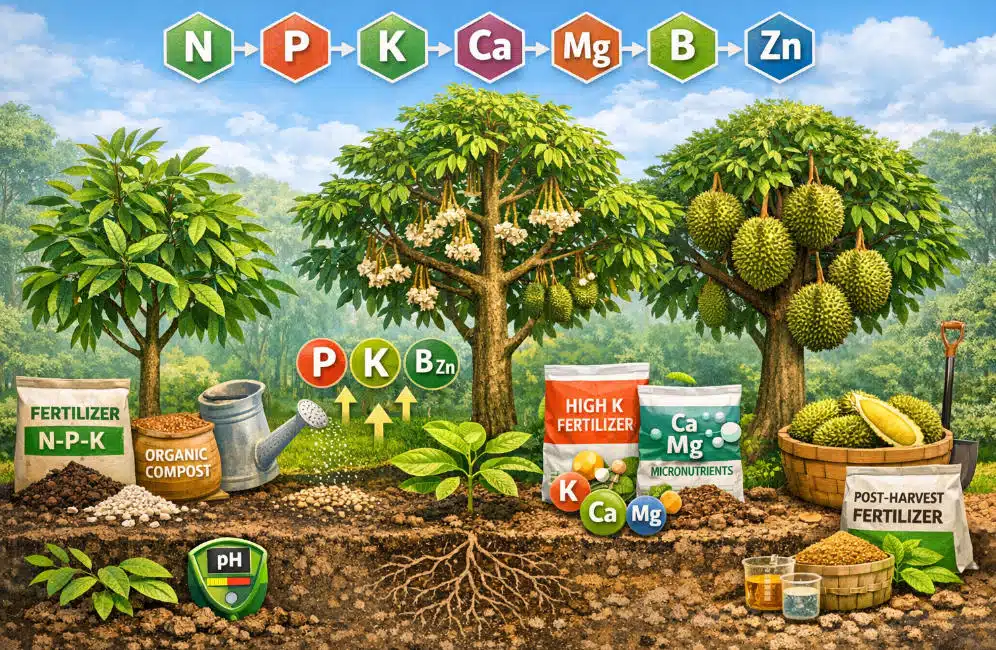
Durian Fertilizer Strategies by Growth Stage
1. Young Tree and Vegetative Growth Stage
During the early years, durian trees focus on root and canopy establishment. At this stage, durian fertilizer for vegetative growth should emphasize:
- Moderate nitrogen for leaf expansion
- Adequate phosphorus for root development
- Organic matter to improve soil structure and microbial activity
Slow-release or organic-based durian fertilizers are often recommended to support steady growth without stressing young trees.
2. Pre-Flowering and Flower Induction Stage
Proper nutrient balance before flowering determines flower quantity and quality. Excess nitrogen during this stage may reduce flower initiation.
Recommended nutrient focus:
- Reduced nitrogen input
- Higher phosphorus and potassium levels
- Micronutrients such as boron and zinc
Many growers use durian fertilizer for flowering to help synchronize bloom and improve flower retention.
3. Fruit Set and Fruit Development Stage
Fruit setting is one of the most nutrient-demanding stages. Potassium demand increases sharply, along with calcium and magnesium.
Key considerations include:
- High-potassium durian fertilizer for fruit development
- Calcium supplementation to reduce fruit cracking
- Balanced micronutrients to prevent fruit drop
At this stage, well-formulated durian fertilizer for fruit setting can significantly improve fruit size, flesh thickness, and uniformity.
4. Post-Harvest Nutrient Recovery
After harvest, durian trees require nutrients to restore energy reserves and prepare for the next cycle.
Post-harvest fertilization should focus on:
- Balanced NPK inputs
- Organic amendments to improve long-term soil fertility
- Trace elements to correct hidden deficiencies
This stage is often overlooked, but proper durian tree nutrient management after harvest directly affects next season’s productivity.
Soil Health and Fertilizer Efficiency
Effective durian fertilizer use depends heavily on soil condition. Poor drainage, low organic matter, or extreme pH levels can limit nutrient uptake even when fertilizers are applied correctly.
Best practices include:
- Regular soil and leaf analysis
- Improving soil structure with compost or organic fertilizer
- Adjusting fertilizer formulations based on soil test results
A sustainable durian fertilizer program combines chemical precision with biological soil health management.
Common Mistakes in Durian Fertilizer Application
Some frequent nutrient management issues include:
- Overuse of nitrogen leading to poor flowering
- Ignoring micronutrient deficiencies
- Applying fertilizer without considering tree age or growth stage
- One-size-fits-all fertilizer programs across different orchards
Tailoring durian fertilizer application to local soil conditions and tree growth stages helps avoid these problems and improves return on investment.
Durian cultivation requires a long-term, stage-based nutrient strategy. By understanding durian tree nutrient requirements and applying the appropriate Durian Fertilizer at each growth stage, growers can improve tree health, stabilize yields, and enhance fruit quality.
A well-designed durian fertilizer program is not about applying more inputs—but about applying nutrients more intelligently.
