
In commercial fruit production, fertilizer application rates directly influence yield performance, fruit quality, and long-term soil sustainability. For fertilizer manufacturers, suppliers, and orchard managers, understanding scientifically balanced Fruit Tree Fertilizer application rates is essential for designing effective nutrient programs and delivering measurable agronomic results.
Unlike backyard fertilization, commercial orchard nutrition requires precision. Rates must be calculated based on tree density, expected yield, soil fertility status, and regional climate conditions. This article outlines practical guidelines from a production and supply-chain perspective.
Understanding Nutrient Demand in Commercial Fruit Production
Fruit trees extract significant nutrients from the soil every production cycle. Nitrogen (N), phosphorus (P), and potassium (K) are required in large quantities, while calcium, magnesium, sulfur, and micronutrients play critical supporting roles.
In high-density orchards, nutrient demand increases due to:
- Greater tree population per hectare
- Intensive pruning systems
- Higher yield targets
- Multiple harvest cycles (for citrus and tropical fruits)
Professional Fruit Tree Fertilizer manufacturers must therefore develop formulations that align with orchard nutrient removal rates and soil replenishment strategies.
Standard Nitrogen-Based Application Rate Models
In commercial orchards, nitrogen is often used as the reference nutrient for rate calculation.
General Nitrogen Requirement (Per Hectare Basis)
Depending on crop type and yield target:
- Apple orchards: 60–120 kg N/ha/year
- Citrus orchards: 150–250 kg N/ha/year
- Stone fruit orchards: 80–150 kg N/ha/year
- Tropical fruit plantations: 120–300 kg N/ha/year
Actual rates should always be adjusted based on:
- Soil testing results
- Leaf tissue analysis
- Target yield (tons per hectare)
- Irrigation system (drip vs. flood)
For fertilizer suppliers serving commercial orchards, offering customized nutrient programs based on these variables adds significant value.
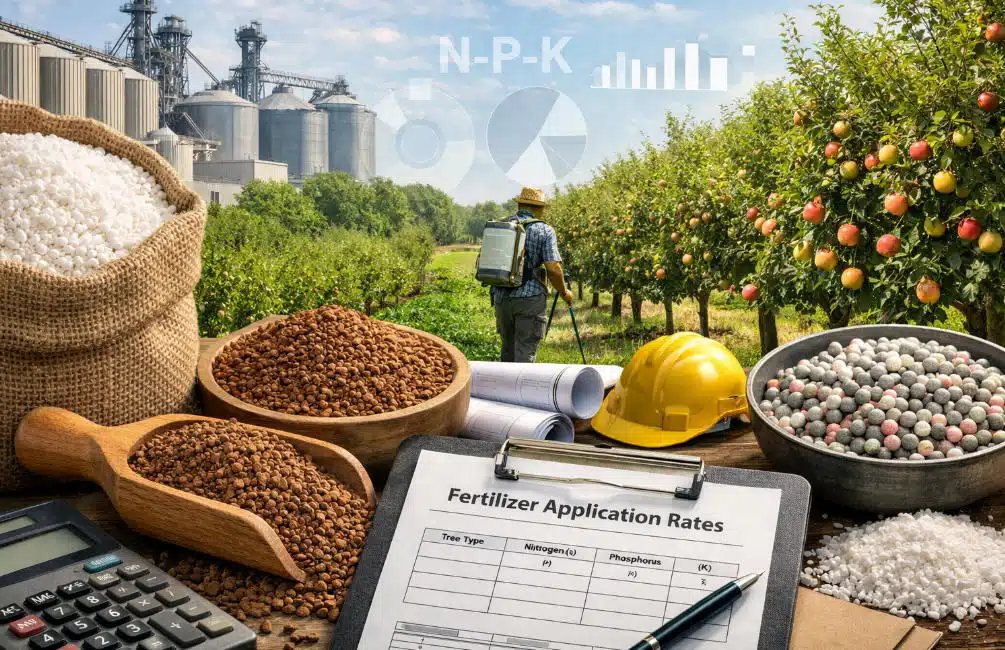
Calculating Bulk Fertilizer Quantities
From a supply perspective, application rate calculations determine bulk order volume.
Example:
If an orchard requires 150 kg of actual nitrogen per hectare and uses a compound NPK 15-15-15 Fruit Tree Fertilizer, the calculation is:
150 ÷ 0.15 = 1,000 kg fertilizer per hectare annually
For a 50-hectare orchard:
1,000 kg × 50 = 50 metric tons per year
This calculation model is critical for:
- Fertilizer factories planning production capacity
- Export-oriented fertilizer suppliers
- OEM fertilizer manufacturers producing private-label orchard fertilizers
Formulation Considerations for Fruit Tree Fertilizer Manufacturers
1. Stage-Specific Fertilizer Programs
Commercial orchards often divide fertilization into growth stages:
- Pre-flowering: Higher phosphorus for root and flower development
- Fruit set stage: Balanced NPK with micronutrients
- Fruit enlargement: Higher potassium ratios
- Post-harvest recovery: Nitrogen + micronutrients
Developing stage-specific Fruit Tree Fertilizer formulations allows manufacturers to provide premium agronomic solutions rather than generic compound fertilizers.
2. Water-Soluble and Fertigation Fertilizers
Modern orchards increasingly rely on drip irrigation and fertigation systems. This creates demand for:
- Fully water-soluble fruit tree fertilizers
- Low-salt index formulations
- Chloride-free potassium sources
- Controlled-release fertilizers (CRF)
Fertilizer factories targeting export markets should consider producing:
- Water-soluble NPK for fruit trees
- Bulk blended fertilizers for orchard distributors
- OEM customized formulations for agricultural brands
3. Organic and Bio-Enhanced Fertilizers
There is growing international demand for:
- Organic fruit tree fertilizer
- Amino acid-enhanced fertilizer
- Humic acid-based orchard fertilizer
- Microbial biofertilizer for fruit trees
For suppliers serving Europe, North America, and Southeast Asia, compliance with organic certification standards and residue regulations is increasingly important.
Application Methods and Rate Optimization
From a technical advisory standpoint, suppliers should guide orchard clients on:
- Broadcasting vs. band application
- Fertigation dosing schedules
- Split nitrogen application (3–5 times per season)
- Integration with soil amendment programs
Improper application rates not only reduce yield but also create environmental risks such as nitrate leaching. Providing data-supported fertilizer recommendations enhances supplier credibility.
Bulk Supply and Export Considerations
For Fruit Tree Fertilizer manufacturers and exporters, understanding application rates helps forecast:
- Annual demand cycles
- Seasonal export peaks
- Packaging formats (25kg, 50kg, jumbo bags)
- Container loading optimization
Large commercial orchards typically purchase in metric tons, requiring stable supply chains and consistent nutrient specifications.
OEM and ODM fertilizer factories can also develop:
- Private label fruit tree fertilizer brands
- Region-specific nutrient ratios
- Customized packaging solutions for distributors
Accurate fruit tree fertilizer application rates form the foundation of commercial orchard success. For manufacturers, suppliers, and fertilizer factories, aligning product formulation with agronomic science ensures better performance, stronger distributor partnerships, and long-term market growth.
By combining soil testing data, crop nutrient demand, and production planning, professional Fruit Tree Fertilizer suppliers can deliver both technical expertise and scalable bulk solutions to commercial growers worldwide.
