
In modern agriculture, the early growth stage of field crops determines much of the final yield potential. Whether it is corn, wheat, soybean, rice, or other staple crops, seedlings are particularly vulnerable to environmental stress. Low temperature, drought, and saline-alkali soil conditions can severely inhibit root development, delay vegetative growth, and ultimately reduce productivity.
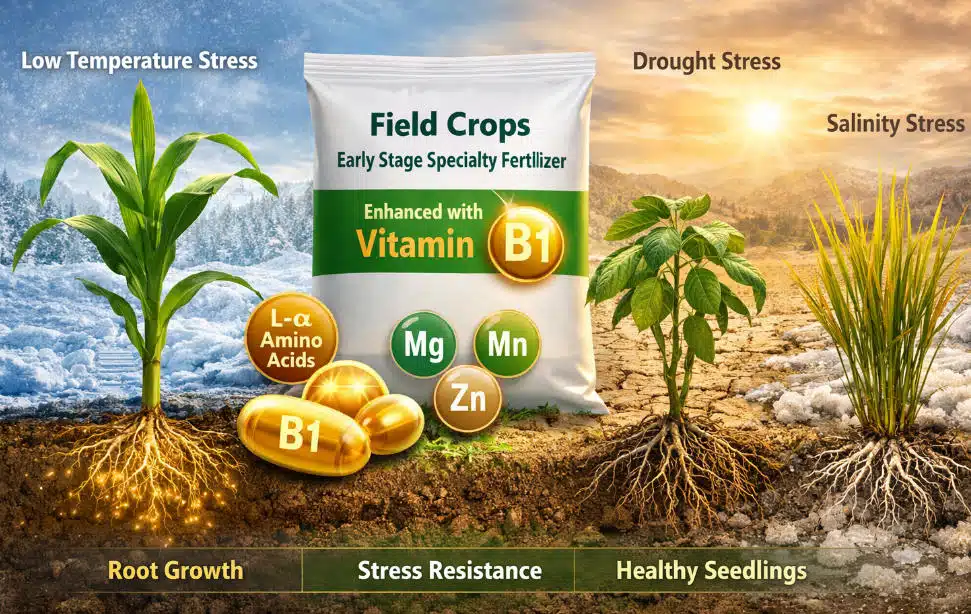
Field Crops Early Stage Specialty Fertilizer is designed to address these early challenges. By integrating highly active L-α free amino acids, chelated secondary and micronutrients, and specially added Vitamin B1, MASL provides targeted nutritional and physiological support when crops need it most.
Why Early-Stage Stress Matters in Field Crops
During germination and early vegetative growth, crops rely heavily on:
- Rapid root establishment
- Efficient nutrient uptake
- Stable chlorophyll formation
- Active cellular energy metabolism
However, environmental stress at this stage can disrupt these processes:
- Low temperature stress slows enzymatic reactions and root activity.
- Drought stress restricts water absorption and nutrient mobility.
- Salinity stress causes osmotic imbalance and ion toxicity, impairing root growth.
Without early intervention, these stress factors can reduce plant vigor and compromise yield formation later in the season.
The Core Technology Behind MASL Early Stage Specialty Fertilizer
1. Highly Active L-α Free Amino Acids
At the heart of MASL’s Field Crops Early Stage Specialty Fertilizer are L-α free amino acids with high biological activity.
Compared with conventional nitrogen sources, L-α free amino acids:
- Are directly absorbed by roots and leaves
- Participate immediately in protein synthesis
- Stimulate root elongation and branching
- Activate cell division and early tissue differentiation
This rapid bioavailability helps seedlings establish a strong root system, forming a stable growth framework for later stages.
2. Chelated Magnesium, Manganese, and Zinc
Micronutrient deficiencies frequently occur in early growth, especially in cold or alkaline soils. MASL incorporates chelated forms of:
- Magnesium (Mg)
- Manganese (Mn)
- Zinc (Zn)
Chelation enhances nutrient stability and absorption efficiency, even under challenging soil conditions.
These elements:
- Support chlorophyll synthesis
- Prevent interveinal chlorosis
- Reduce leaf spotting caused by micronutrient deficiencies
- Improve photosynthetic efficiency
- Enhance carbohydrate transport to growing tissues
By strengthening photosynthesis and nutrient translocation, crops can better withstand early environmental fluctuations.
The Special Role of Vitamin B1 in Stress Mitigation
A key innovation in MASL’s formulation is the special addition of Vitamin B1 (thiamine).
Vitamin B1 as a Metabolic Coenzyme
Vitamin B1 plays a central role in plant energy metabolism. As a coenzyme in carbohydrate metabolism, it supports:
- ATP production
- Enzymatic activation
- Cellular respiration
- Synthesis of essential metabolites
When crops face stress, energy demand increases while metabolic efficiency declines. Supplementing Vitamin B1 helps stabilize physiological processes during these critical periods.
How Vitamin B1 Reduces Early-Stage Stress
1. Low Temperature Stress Relief
Cold conditions slow metabolic reactions and restrict nutrient transport. Vitamin B1 enhances enzymatic activity involved in energy production, helping seedlings maintain basic metabolic functions even under suboptimal temperatures. This reduces growth stagnation and supports continued root activity.
2. Drought Stress Mitigation
Under drought conditions, plants experience osmotic stress and impaired nutrient uptake. Vitamin B1 supports cellular integrity and improves metabolic adjustment, enabling seedlings to maintain growth vitality despite limited water availability.
3. Salinity Stress Tolerance
Saline-alkali soils disrupt ion balance and inhibit root elongation. By strengthening energy metabolism and physiological regulation, Vitamin B1 helps reduce the inhibitory effects of salinity on early root development, allowing crops to establish more stable growth in marginal soils.
Integrated Benefits of Field Crops Early Stage Specialty Fertilizer
The combination of L-α free amino acids, chelated micronutrients, and Vitamin B1 creates a synergistic effect:
- Faster seedling establishment
- Stronger root system expansion
- Improved early vegetative growth
- Enhanced photosynthetic performance
- Reduced physiological disorders
- Greater resilience against low temperature, drought, and salinity
This makes MASL’s Field Crops Early Stage Specialty Fertilizer particularly suitable for:
- Spring planting under fluctuating temperatures
- Dryland farming systems
- Saline-alkali soil improvement areas
- Intensive, high-yield field crop production
Application Scenarios and Target Crops
MASL’s formulation is developed specifically for:
- Corn early stage fertilizer programs
- Wheat seedling stress management
- Soybean early vegetative growth support
- Rice transplant establishment enhancement
It can be integrated into basal fertilization or early top-dressing programs to provide targeted early nutrition.
Building a Strong Foundation for Yield
Yield formation begins at the seedling stage. Nutritional imbalances or stress damage during early growth cannot always be fully corrected later. By focusing on early-stage physiological regulation, energy metabolism, and micronutrient balance, MASL’s Field Crops Early Stage Specialty Fertilizer helps establish a strong structural and metabolic foundation for the entire crop cycle.
Early protection means stronger plants, better stress tolerance, and more stable yield performance under variable environmental conditions.
