
When growers ask about fruit tree fertilizer application rates, they are usually not looking for textbook numbers. What they really want to know is simple: How much is enough to produce strong yields without wasting money or damaging the soil?
The truth is, there isn’t a universal formula. Fertilizing an orchard is part science, part observation, and part long-term strategy. Application rates depend on tree age, soil condition, expected yield, irrigation method, and even the variety being grown. What works in one orchard may not work in another.
At MASL, we’ve worked with commercial orchards across different climates, and one pattern is consistent: growers who adjust fertilizer rates based on real field data consistently outperform those who follow fixed schedules year after year.
Let’s break down what actually matters.
Start With the Tree, Not the Bag
Many fertilization mistakes begin with the product instead of the crop. Before choosing an NPK ratio or calculating how much fertilizer for fruit trees per year, look at the growth stage of the orchard.
Young Trees: Building Structure
In the first few years, trees are focused on root development and canopy formation. Excess nitrogen during this stage can create overly vigorous shoots but weak structural growth.
For young orchards, fruit tree fertilizer application rates should be moderate and split into smaller doses. A balanced NPK fertilizer for fruit trees, applied during active growth periods, usually performs better than one heavy early-season application.
Mature Trees: Supporting Production
Once trees begin bearing fruit, nutrient demand shifts. Nitrogen is still important, but potassium becomes critical during fruit enlargement and sugar accumulation. Many growers underestimate potassium, especially when calculating fertilizer rate for apple orchard systems or high-density plantings.
Mature orchards generally require higher overall nutrient input, but timing becomes more important than quantity. Applying too much nitrogen late in the season can reduce fruit firmness and storage quality.
Soil Testing Changes Everything
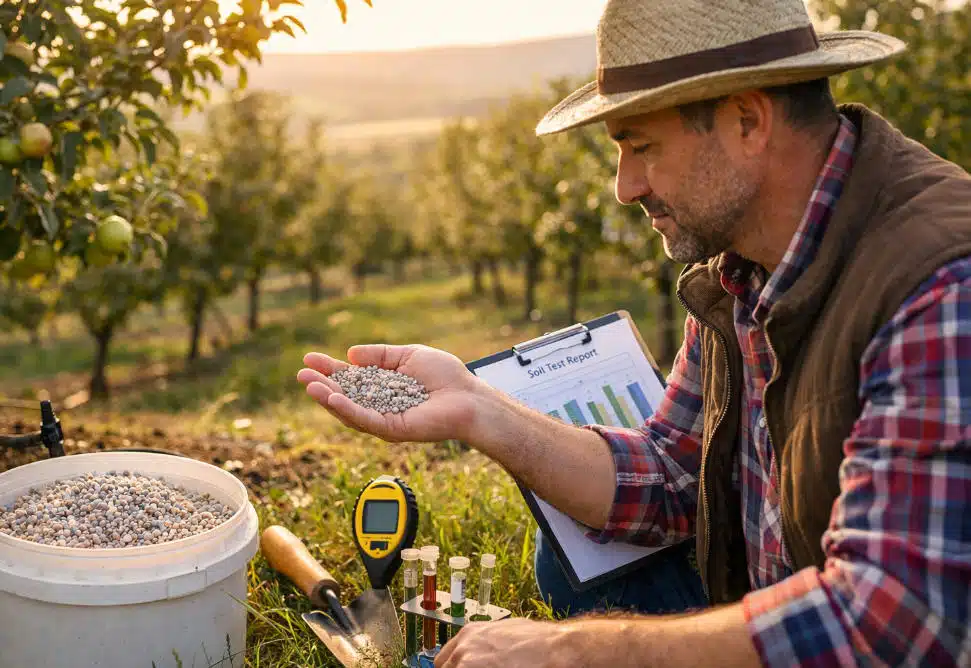
It’s impossible to talk seriously about fruit tree fertilizer application rates per acre without mentioning soil analysis. Two orchards with identical tree spacing can require completely different fertilizer programs simply because of soil nutrient reserves.
Soil testing helps answer questions like:
- Is nitrogen already sufficient from organic matter?
- Is phosphorus locked up due to pH imbalance?
- Is potassium being depleted after several heavy crop years?
Growers who skip testing often either overspend on fertilizer or slowly mine nutrients from the soil without realizing it.
Leaf tissue analysis during the growing season provides another layer of clarity. When soil data and leaf data are combined, orchard fertilizer management becomes much more precise.
Think in Terms of Nutrient Removal
One practical way to approach fruit tree fertilizer rates is to calculate nutrient removal based on yield.
For example, if an orchard produces 20 tons per acre and each ton removes a measurable amount of nitrogen, phosphorus, and potassium, that removal must eventually be replaced. Otherwise, productivity declines over time.
This method shifts the mindset from “How much should I apply?” to “How much did the crop actually use?”
It also prevents unnecessary over-application, which is especially important in drip-irrigated orchards using water-soluble or fertigation systems.
Timing Is Often More Important Than Volume
Instead of one large seasonal application, splitting fertilizer into stages usually improves uptake efficiency:
- Early spring: support bud break and initial growth
- Pre-flowering: stabilize nutrient supply
- Fruit expansion: increase potassium availability
- Post-harvest: replenish reserves for next season
This staged approach works particularly well with controlled-release fruit tree fertilizer or fertigation programs.
Applying nutrients closer to peak demand reduces leaching, improves nutrient use efficiency, and lowers long-term costs.
Common Fertilization Patterns That Hurt Yields
Even experienced growers sometimes fall into habits that limit performance:
- Applying nitrogen based solely on last year’s rate
- Ignoring potassium during fruit sizing
- Skipping micronutrients such as boron and zinc
- Applying fertilizer without adjusting for unusually high yields
Sustainable fruit tree fertilization requires periodic adjustment. High-yield seasons remove more nutrients than average seasons. If rates aren’t recalibrated, the orchard gradually becomes nutrient-deficient.
Modern Approaches to Fruit Tree Fertilizer Programs
Today’s orchards are becoming more data-driven. Precision fertigation, controlled-release formulations, and targeted nutrient blends are replacing traditional broadcast-only methods.
Many commercial growers are moving toward:
- Customized NPK fertilizer for fruit trees
- Drip-compatible soluble formulations
- Integrated soil fertility management strategies
- Yield-based fertilizer planning
At MASL, we support orchards with adaptable fruit tree fertilizer programs designed around real production targets rather than generalized recommendations. This includes adjusting fruit tree fertilizer per acre calculations according to soil structure, irrigation systems, and regional climate conditions.
The goal isn’t simply higher application rates. It’s better nutrient efficiency and long-term soil balance.
So, How Much Fertilizer Do Fruit Trees Really Need?
There is no single number that fits every orchard. However, a practical framework looks like this:
- Test soil before the season
- Monitor leaf tissue mid-season
- Estimate expected yield
- Calculate nutrient removal
- Adjust fertilizer input accordingly
When growers follow this process, fruit tree fertilizer application rates become logical instead of guesswork.
The result is healthier trees, stable yields, better fruit quality, and improved return on investment.
Fertilizing fruit trees is not about applying more—it’s about applying correctly. Understanding nutrient demand, monitoring soil health, and adjusting rates based on yield performance creates a sustainable system.
Whether managing a small orchard or calculating fertilizer rate for apple orchard production at commercial scale, thoughtful planning always outperforms routine application.
A well-designed fruit tree fertilizer strategy supports not just this year’s harvest, but the long-term productivity of the orchard itself.
