
Introduction: Why Soil Testing Matters in Durian Orchards
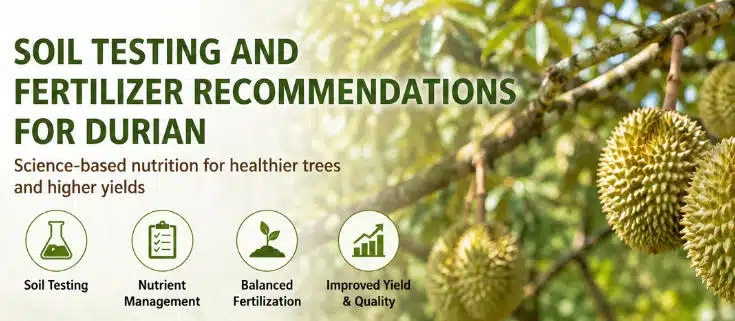
Durian cultivation is highly dependent on balanced soil nutrition. Even when growers apply large amounts of fertilizer, poor nutrient management can still result in weak vegetative growth, flower drop, low fruit set, uneven fruit size, or declining orchard productivity. One of the most common reasons is the absence of proper soil testing before fertilizer application.
Durian trees are long-term perennial crops with high nutrient demand throughout different growth stages. Soil conditions directly influence root development, nutrient absorption efficiency, microbial activity, and fruit quality. Without understanding the actual nutrient status of the orchard soil, fertilizer applications often become inefficient and costly.
Soil testing provides scientific data that helps growers:
- Identify nutrient deficiencies or excesses
- Adjust fertilizer formulas accurately
- Optimize fertilizer investment
- Improve soil structure and microbial activity
- Increase fruit yield and quality
- Reduce environmental nutrient loss
Modern durian orchard management increasingly relies on data-driven fertilization strategies rather than traditional experience-based application methods. This approach allows growers to achieve more stable production and healthier trees over the long term.
How to Conduct Soil Tests for Durian Orchards
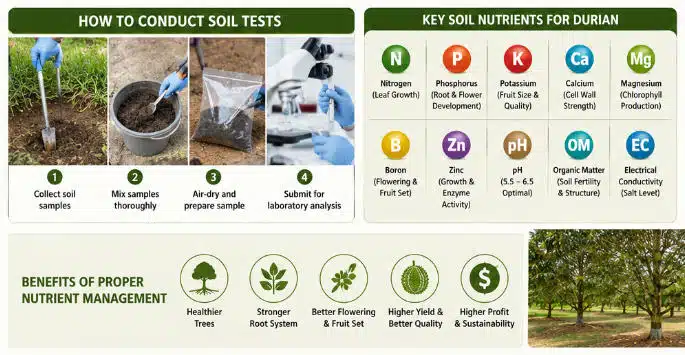
Accurate soil analysis begins with proper sampling methods. Poor sampling can lead to misleading laboratory results and incorrect fertilizer recommendations.
1. Determine the Sampling Area
Large orchards should be divided into several management zones according to:
- Tree age
- Soil type
- Terrain condition
- Irrigation pattern
- Productivity differences
Each zone should be tested separately to obtain more accurate nutrient data.
2. Collect Soil Samples Correctly
For durian orchards, soil should normally be collected from the root activity zone.
Recommended Sampling Depth
- Young trees: 0–20 cm
- Mature trees: 20–40 cm
Samples should be taken around the drip line rather than directly near the trunk.
Sampling Procedure
- Remove surface debris and weeds
- Dig small holes at several points
- Collect equal amounts of soil from each location
- Mix thoroughly in a clean container
- Air-dry the mixed sample before laboratory submission
Usually, 8–15 sub-samples are combined into one representative sample for each orchard block.
3. Key Parameters to Analyze
A comprehensive durian soil test should include:
| Parameter | Importance for Durian Trees |
|---|---|
| Soil pH | Influences nutrient availability |
| Organic Matter | Improves soil fertility and water retention |
| Nitrogen (N) | Supports vegetative growth |
| Phosphorus (P) | Promotes root and flower development |
| Potassium (K) | Essential for fruit quality and size |
| Calcium (Ca) | Strengthens cell structure |
| Magnesium (Mg) | Critical for chlorophyll production |
| Boron (B) | Improves flowering and fruit set |
| Zinc (Zn) | Supports enzyme activity and growth |
| Electrical Conductivity (EC) | Indicates salt accumulation |
Ideal Soil Conditions for Durian Cultivation
Durian trees grow best under slightly acidic and well-drained soil conditions.
Optimal Soil pH
pH=5.5∼6.5
When soil pH falls below this range, nutrient availability decreases and aluminum toxicity may occur. Excessively alkaline soil can also reduce micronutrient uptake, especially iron and zinc.
Organic Matter Requirements
Healthy durian orchards should maintain sufficient organic matter to improve:
- Soil aeration
- Water retention
- Root activity
- Beneficial microbial populations
Low organic matter soils often experience nutrient leaching and unstable tree performance during dry seasons.
Interpreting Soil Test Results for Fertilizer Planning
Understanding laboratory data is essential for designing an effective fertilization program.
Nitrogen Deficiency Symptoms
Low nitrogen levels often cause:
- Pale green or yellow leaves
- Reduced canopy growth
- Weak branch development
Excess nitrogen, however, may stimulate excessive vegetative growth while reducing flowering performance.
Phosphorus Management
Phosphorus deficiency can result in:
- Slow root development
- Delayed flowering
- Poor fruit formation
In acidic tropical soils, phosphorus fixation is common, making efficient fertilizer selection especially important.
Potassium and Fruit Quality
Potassium is one of the most critical nutrients during fruit development.
High potassium availability improves:
- Fruit size
- Sugar accumulation
- Flesh texture
- Disease resistance
- Shelf life
Many commercial durian orchards increase potassium application during fruit expansion stages.
Calcium and Magnesium Balance
Calcium and magnesium interact closely in soil chemistry. Imbalanced applications may reduce nutrient uptake efficiency.
Common Symptoms
| Deficiency | Symptoms |
|---|---|
| Calcium | Weak root growth, fruit cracking |
| Magnesium | Interveinal yellowing on older leaves |
Balanced fertilization is therefore essential for sustainable orchard productivity.
MASL Biotech Fertilizer Recommendations for Durian Orchards
As a professional fertilizer manufacturer and supplier, MASL Biotech provides targeted nutrient solutions for tropical fruit orchards, including durian plantations.
1. Base Fertilizer Programs
For orchard establishment and vegetative growth stages, balanced NPK formulations are recommended to support root expansion and canopy development.
Typical applications include:
- Compound NPK fertilizers
- Organic soil conditioners
- Humic acid amendments
- Controlled-release fertilizers
These products help stabilize nutrient availability and improve soil structure.
2. Flowering Stage Nutrition
Before flowering, fertilizer programs should gradually reduce excessive nitrogen while increasing phosphorus and micronutrients.
Important nutrients include:
- Phosphorus
- Boron
- Zinc
- Calcium
This nutritional adjustment supports better flower initiation and fruit set stability.
3. Fruit Development Fertilization
During fruit enlargement, potassium demand rises significantly.
K>N
Higher potassium ratios help improve:
- Fruit filling
- Flavor development
- Dry matter accumulation
- Commercial fruit quality
MASL Biotech fertilizer solutions are designed to support these nutrient transitions throughout the growing cycle.
4. Soil Improvement Solutions
In degraded orchard soils, additional amendments may be required, including:
- Organic compost
- Bio-organic fertilizers
- Calcium-magnesium conditioners
- Microbial soil enhancers
Long-term soil rehabilitation improves fertilizer efficiency and root health.
Case Examples: Improved Growth and Yield Through Soil Testing
Case 1: Correcting Acidic Soil Conditions
A Southeast Asian durian orchard experienced poor root growth and low flowering rates despite frequent fertilizer application.
Soil testing revealed:
- Soil pH below 4.8
- Calcium deficiency
- Low organic matter
After implementing lime application, organic matter improvement, and balanced fertilization, the orchard achieved:
- Stronger vegetative growth
- Improved flowering uniformity
- Higher fruit retention
Within two production cycles, overall yield increased substantially.
Case 2: Potassium Optimization During Fruiting
Another orchard faced inconsistent fruit size and weak flavor quality.
Laboratory analysis identified:
- Insufficient potassium levels
- Excess nitrogen application
After adjusting fertilizer ratios toward higher potassium nutrition during fruit development, growers observed:
- Larger fruits
- Better pulp texture
- Improved market value
- Enhanced fruit consistency
Common Mistakes in Durian Fertilizer Management
Many nutrient problems originate from improper fertilizer practices.
Over-Fertilization
Applying excessive fertilizer may cause:
- Salt accumulation
- Root damage
- Nutrient imbalance
- Increased production cost
Ignoring Soil pH
Even nutrient-rich soil becomes ineffective if pH conditions limit nutrient availability.
Regular pH monitoring is therefore essential.
Applying Fertilizer Without Growth-Stage Planning
Durian trees require different nutrient ratios during:
- Vegetative growth
- Flower induction
- Fruit set
- Fruit enlargement
- Post-harvest recovery
Using the same fertilizer formula year-round often reduces efficiency.
Conclusion: Science-Based Fertilization for Sustainable Durian Production
Successful durian cultivation depends on more than simply applying large quantities of fertilizer. Modern orchards increasingly rely on soil testing and scientific nutrient management to improve productivity, fruit quality, and long-term soil health.
By understanding soil conditions and matching fertilizer programs to tree growth stages, growers can:
- Improve nutrient efficiency
- Reduce unnecessary fertilizer costs
- Increase yield consistency
- Enhance fruit quality
- Build healthier orchard ecosystems
Professional nutrient solutions from MASL Biotech help durian growers implement precision fertilization strategies that support sustainable orchard success and higher commercial returns.
