
Understanding Nutrient Needs in Mid-to-Late Wheat Development
The later stages of wheat growth—spanning booting, heading, flowering, and grain filling—are decisive for final yield and grain quality. During this period, wheat transitions from vegetative growth to reproductive development, requiring not only sufficient nutrients but also high physiological efficiency. Inadequate nutrition or poor nutrient utilization at this stage can lead to weak ear differentiation, poor pollination, premature senescence, and incomplete grain filling.
A scientifically formulated Wheat Late Stage Specialty Fertilizer is designed to meet these precise physiological demands, supporting both yield formation and quality improvement.
Promoting Ear Differentiation and Uniform Heading
In the mid-to-late growth stages, wheat ear differentiation and uniform ear emergence are critical for achieving stable yield. Highly active L-α free amino acids serve as bioavailable metabolic substrates, directly participating in protein synthesis and enzyme activation. Their application at this stage:
- Supports smooth transition from vegetative to reproductive growth
- Enhances ear differentiation and panicle formation rate
- Promotes uniform heading and synchronized flowering
This balanced development reduces population inconsistency and lays the foundation for effective pollination and grain set.
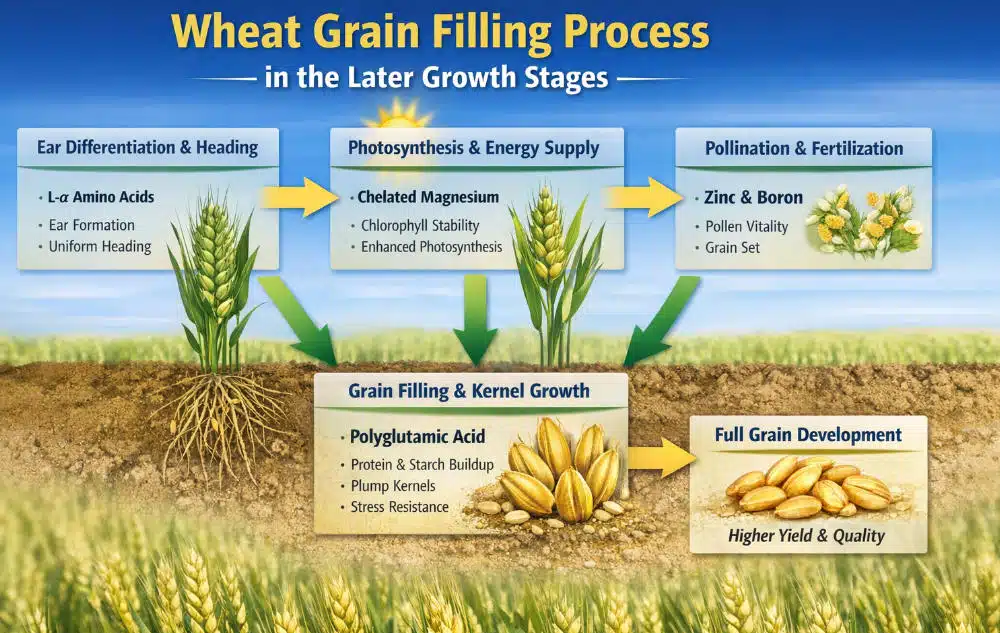
Enhancing Photosynthesis During Flowering and Grain Filling
From flowering through grain filling, wheat yield relies heavily on sustained photosynthetic activity. This fertilizer integrates chelated Magnesium, a central component of chlorophyll molecules, working synergistically with amino acids to:
- Maintain chlorophyll stability under high metabolic demand
- Improve photosynthetic efficiency and carbon assimilation
- Ensure sufficient energy supply for developing grains
By preserving functional leaf activity, wheat plants can continuously supply carbohydrates needed for kernel development.
Improving Pollination and Reducing Empty Grains
Grain number and quality are closely linked to pollination success. The inclusion of chelated Zinc and Boron addresses key reproductive processes:
- Zinc activates starch synthase and supports enzyme systems involved in grain formation
- Boron enhances pollen vitality, pollen tube elongation, and fertilization quality
Together, these nutrients reduce floret degeneration and empty grains, while promoting effective fertilization and early grain development.
Supporting Grain Filling and Kernel Weight Formation
During grain filling, the demand for assimilates and nutrients peaks. The fertilizer’s balanced formulation promotes:
- Protein and starch accumulation within the endosperm
- Plumper grains and increased thousand-kernel weight
- Improved grain density and overall quality
This targeted nutritional support ensures that yield potential established earlier in the season is fully realized.
Extending Functional Leaf Life and Stress Resistance
Late-season stresses such as dry hot wind and high temperatures often accelerate leaf senescence, shortening the grain filling period. The addition of Polyglutamic Acid (γ-PGA) provides multiple physiological benefits:
- Reduces nutrient leaching and improves nutrient retention
- Enhances root activity and nutrient uptake efficiency
- Delays plant senescence and prolongs functional leaf photosynthesis
- Improves stress resistance under heat and drought conditions
By extending the effective grain filling duration, wheat plants achieve more complete kernel development and stable yield performance.
Achieving Yield and Quality Improvement in Late-Stage Wheat
Proper fertilization during the later stages of wheat growth is not about increasing nutrient quantity, but about optimizing nutrient efficiency and physiological balance. A Wheat Late Stage Specialty Fertilizer, formulated with highly active amino acids, chelated micronutrients, and polyglutamic acid, provides continuous and targeted nutrition that aligns with wheat’s reproductive and grain filling processes.
This approach ensures full grain filling, enhanced stress tolerance, improved kernel weight, and consistent quality—key factors for achieving high and stable wheat yields.


