
Cassava is one of the world’s most important root crops, serving as a staple food and industrial raw material in many tropical and subtropical regions. To achieve stable and high yields, proper nutrient management is essential. Choosing the right cassava fertilizer and applying it at the correct growth stages can significantly improve tuber size, starch content, and overall productivity.
This guide explains how fertilizer for cassava yield works, what nutrients cassava needs most, and how farmers can optimize fertilization for sustainable and profitable cassava cultivation.
Understanding Cassava Nutrient Requirements
Cassava is a high biomass crop with a long growing cycle, which means it removes large amounts of nutrients from the soil. Without balanced fertilization, yields decline rapidly over time.
Key Nutrients for Cassava Growth
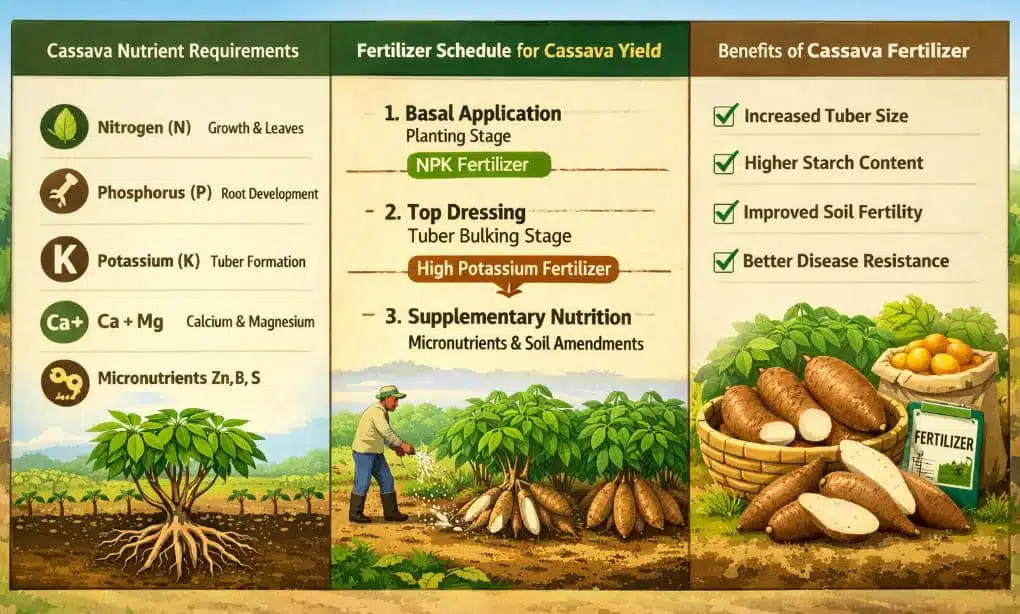
- Nitrogen (N): Supports early vegetative growth, leaf development, and photosynthesis.
- Phosphorus (P): Promotes strong root initiation and early tuber formation.
- Potassium (K): The most critical nutrient for cassava yield; enhances tuber bulking, starch accumulation, and disease resistance.
- Calcium (Ca) & Magnesium (Mg): Improve root quality and nutrient uptake.
- Micronutrients (Zn, B, S): Support enzyme activity and healthy plant metabolism.
A well-formulated cassava fertilizer ensures that these nutrients are available throughout the crop’s growth stages.
Why Cassava Fertilizer Is Essential for High Yield
Many cassava fields are located on marginal or nutrient-depleted soils. Relying only on natural soil fertility often leads to:
- Small or uneven tuber development
- Low starch content
- Delayed maturity
- Reduced resistance to drought and disease
Using the right fertilizer for cassava yield helps:
- Increase tuber number and weight
- Improve starch and dry matter content
- Enhance nutrient use efficiency
- Maintain long-term soil productivity
Best Fertilizer Strategy for Cassava Yield
1. Basal Fertilization (Planting Stage)
Apply a balanced NPK fertilizer at planting or shortly after sprouting.
Recommended focus:
- Moderate nitrogen
- Adequate phosphorus
- High potassium
This supports strong early growth and healthy root establishment.
2. Top Dressing (Vegetative to Tuber Bulking Stage)
As cassava enters rapid growth and tuber expansion, nutrient demand increases sharply.
Key focus:
- High potassium fertilizer
- Controlled nitrogen to avoid excessive leaf growth
This stage is critical for maximizing cassava yield and tuber size.
3. Supplementary Nutrition
In poor soils or high-yield systems, additional applications may be needed:
- Potassium sulfate for starch accumulation
- Calcium and magnesium to improve tuber quality
- Micronutrient fertilizers to prevent hidden deficiencies
Organic and Integrated Fertilizer Approaches
Combining chemical cassava fertilizer with organic inputs often produces the best results.
Effective options include:
- Farmyard manure or compost to improve soil structure
- Bio-fertilizers to enhance nutrient availability
- Humic and fulvic acids to stimulate root growth
Integrated nutrient management not only boosts cassava yield but also improves soil health over time.
Common Fertilization Mistakes to Avoid
- Overusing nitrogen: Leads to excessive foliage and poor tuber formation
- Ignoring potassium: Results in low yield and low starch content
- Uneven application: Causes irregular root development
- No soil testing: Increases costs and reduces fertilizer efficiency
A soil test before planting helps determine the most effective cassava fertilizer formula.
Final Thoughts: Choosing the Right Cassava Fertilizer
To achieve high and stable cassava yields, farmers must move beyond basic fertilization practices. A targeted fertilizer for cassava yield—rich in potassium, balanced in nitrogen and phosphorus, and supplemented with secondary nutrients—can dramatically improve both yield and quality.
By applying the right cassava fertilizer at the right time, growers can increase profitability, improve starch output, and ensure sustainable cassava production for years to come.


