
Fertilizer is a key component of successful cotton cultivation. A well-planned fertilizer schedule ensures the crop has access to the right nutrients at the right time — supporting healthy plant development, good boll formation, and optimal fiber yield. This article outlines a practical sugar-cane-neutral guideline for fertilizing cotton, discusses the major nutrients involved, and explains why timing and soil testing matter. We also highlight how an agritech company like Masl Biotech can help growers build balanced fertilizer plans, without turning this article into a marketing pitch.
Why Fertilizer Timing and Nutrient Balance Matter for Cotton
Cotton plants have dynamic nutrient needs throughout their growth cycle. According to agronomic research and extension guidelines, nutrient uptake — especially of nitrogen (N), phosphorus (P), and potassium (K) — is closely tied to growth stage and environmental conditions. cotton.org
- Early in the season (seedling and establishment), nutrient demand is relatively low, especially for nitrogen. Ask IFAS
- As cotton moves toward squaring, flowering and boll formation, nutrient demand increases sharply.
- Supplying too much nitrogen too early (or too late) can be harmful — excessive N may delay maturity, promote excessive vegetative growth, reduce fiber quality, and increase vulnerability to pests or boll rot.
- Balanced nutrition — including macronutrients beyond NPK (such as Ca, Mg, S), and micronutrients when needed — also supports healthy crop growth and fiber quality.
Because of these dynamics, a one-time blanket fertilizer application rarely meets cotton’s needs efficiently. A more effective approach relies on soil tests, growth-stage-based scheduling, and split applications or top-dressings.
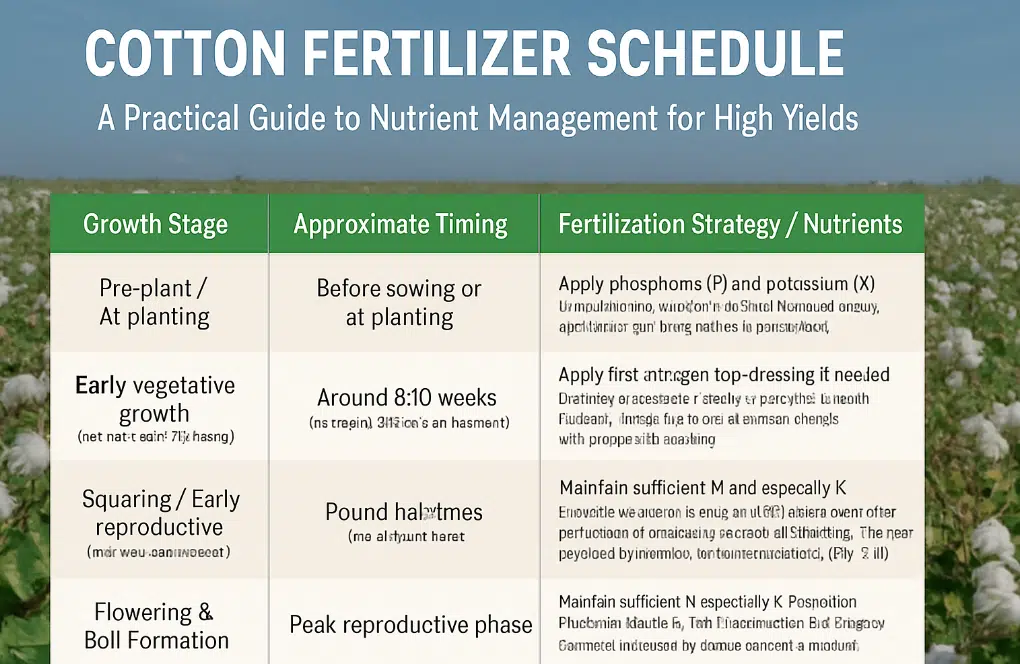
Typical Fertilizer Schedule for Cotton
Below is a generic fertilizer schedule for cotton. Actual rates and timing should always be adjusted based on local soil conditions, climate, irrigation method, and soil test results.
| Growth Stage | Approximate Timing | Fertilization Strategy / Nutrients |
|---|---|---|
| Pre-plant / At planting | Before sowing or at planting | Apply phosphorus (P) and potassium (K) near the root zone (band or row placement). Optionally, incorporate any needed secondary nutrients (e.g., Ca, Mg, S) or soil amendments. Starter fertilizers with modest nitrogen could be beneficial on soils low in fertility or under cool, damp conditions. |
| Early vegetative growth (first few weeks / around 3–8 weeks) | As plant establishes and begins to grow | Apply first nitrogen top-dressing if needed (but avoid excessive N early to prevent rank growth). Provide potassium if soil test shows deficiency. |
| Squaring / Early reproductive (squares, first blooms) | Around 8–10 weeks (varies by cultivar and environment) | Side-dress remaining N in split doses for efficient uptake. Ensure adequate supply of K, as demand begins rising. Provide any required micronutrients (e.g., boron) especially if soil test shows deficiency. |
| Flowering & Boll Formation | Peak reproductive phase | Maintain sufficient N and especially K — potassium becomes critical for boll development and fiber quality. Monitor for signs of deficiency, use foliar or fertigation if needed. Secondary nutrients and micronutrients (Mg, S, B, etc.) should be kept balanced. |
| Boll Maturation → Pre-Harvest | Final few weeks before harvest | Avoid heavy nitrogen application at this stage — excessive late N can delay fiber maturity and reduce quality. Provide potassium if needed to support fiber strength/maturity. Depending on soil and tissue tests, consider foliar micronutrients, but proceed carefully to avoid imbalances. |
Typical total nutrient guidelines (per hectare): Under many production systems, a cotton crop may require in the ballpark of 200–235 kg N, 80–110 kg P₂O₅, and 200–250 kg K₂O per hectare when aiming for high yield.
These amounts are approximate — actual requirement depends on yield goals, soil residual fertility, previous crop history, soil test results, and environmental conditions.
The Role of Soil Testing and Monitoring
A fundamental principle for cotton fertilization is know what’s in your soil before applying more. Soil testing (for residual nitrate, P, K, pH, and other nutrients) before planting — and periodically during the season — is the most reliable foundation for a balanced fertilizer program.
In-season monitoring (e.g., tissue analysis, petiole nitrate tests, visual scouting) helps detect nutrient deficiencies or excesses, allowing adjustments in fertilizer application (timing, method, rate) and avoiding the risks associated with overfertilization (nutrient runoff, delayed maturity, pest/disease pressure).
Integrating Professional Agritech — Example: Masl Biotech
Companies such as Masl Biotech can support cotton growers in building tailored fertilization programs. For example:
- They can help interpret soil test results and recommend nutrient blends matched to local soil conditions, yield goals, and climate.
- They can offer balanced fertilizer formulations or soil amendment solutions (macronutrients, micronutrients, organic matter) to ensure the crop gets a complete nutrition package.
- They may provide advisory support for split-application scheduling, fertigation or foliar feeding (if irrigation/facility allows), and monitoring strategies.
Using such expertise does not mean replacing good agronomic practices — rather, it helps fine-tune nutrient management for efficiency, cost-effectiveness, and sustainable yield.
Challenges & Considerations
- Soil and environmental variability: Because soils differ (texture, organic matter, pH, residual fertility) and weather conditions vary, a “one size fits all” schedule may under- or over-apply nutrients. That is why soil testing is vital.
- Risk of overfertilization: Especially with nitrogen — too much N, or N applied at the wrong time, can lead to delayed maturity, low fiber quality, more pest/disease problems, and inefficient use of resources.
- Micronutrients and secondary nutrients: While much attention is on NPK, neglecting secondary nutrients (Ca, Mg, S) or key micronutrients (B, etc.) can harm root development, enzyme activity, fiber development, and overall plant health.
- Irrigation and water management: Nutrient uptake is strongly linked to water availability. Poor irrigation or drought stress can limit nutrient absorption even if fertilizers are applied correctly.
Conclusion
An effective “cotton fertilizer schedule” balances timing, nutrient composition, and application method to match the crop’s changing needs over the season. With careful soil testing, split applications of N, and appropriate management of P, K, and secondary/micronutrients — supplemented when needed by foliar or fertigation methods — growers can support healthy, high-yielding cotton crops.
Working with knowledgeable agritech partners such as Masl Biotech can help tailor fertilization programs to local soil and climate conditions — enhancing efficiency and sustainability, while minimizing waste or environmental risk.
Proper fertilizer management is not a guarantee of success, but it is a foundational element of cotton agronomy when combined with good crop management, pest control, irrigation, and field practices.


