
In modern legume production, yield is no longer determined only by early vegetative vigor. For crops such as soybean, pea, and mung bean, the true “decisive moment” occurs from pod setting to grain filling. During this period, nutrient imbalance, premature leaf senescence, and poor assimilate transport can lead to flower drop, empty pods, shriveled seeds, and reduced protein accumulation.
A targeted Field Crops Late Stage Specialty Fertilizer acts as a “pod-setting guardian,” helping growers secure higher pod set rates and fuller grains through precise nutrient management.
Why the Late Stage Determines Final Yield in Legumes
Unlike cereals, legumes allocate a large portion of their assimilates to seed protein synthesis. From flowering to grain filling, plants must simultaneously:
- Maintain active photosynthesis
- Support rapid cell division inside developing seeds
- Transport carbohydrates and amino acids efficiently to pods
- Prevent premature aging of leaves
If nutrient supply is unstable—particularly Magnesium (Mg), Zinc (Zn), Boron (B), and amino acid precursors—pod abortion increases and grain plumpness declines. Therefore, late stage nutrient management for soybeans and peas becomes critical for both yield and quality.
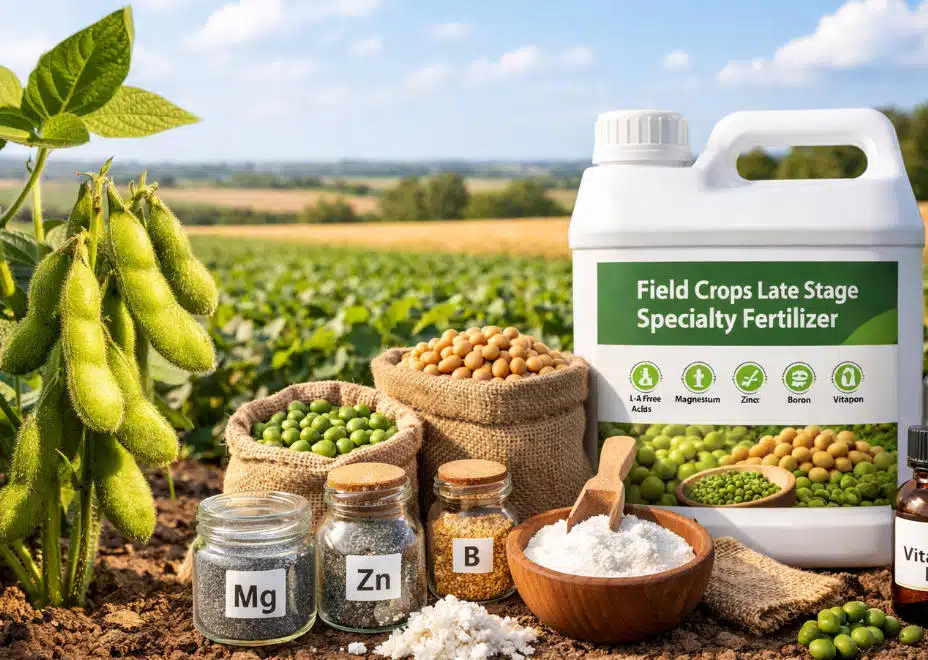
The Science Behind Field Crops Late Stage Specialty Fertilizer
MASL’s solution is specifically developed for the mid-to-late growth needs of field crops, especially legumes during pod setting and grain filling stages. Its formulation is built on three scientific pillars:
1. Highly Active L-α Free Amino Acids – The Metabolic Engine
L-α free amino acids are directly absorbed and rapidly utilized by plants. They:
- Accelerate protein synthesis in developing seeds
- Enhance stress tolerance during reproductive growth
- Improve nutrient transport efficiency
- Reduce energy consumption compared to nitrogen conversion
For soybean pod filling fertilizer programs, amino acids play a direct role in boosting seed protein accumulation and dry matter formation.
2. Chelated Magnesium, Zinc & Boron – The Pod-Setting Trio
Balanced micronutrient supply is essential during reproductive growth.
- Magnesium (Mg) supports chlorophyll stability and sustained photosynthesis.
- Zinc (Zn) promotes enzyme activity and grain development.
- Boron (B) plays a key role in pollen viability, fertilization, and cell wall formation, significantly improving pod set rate and reducing empty pods.
Chelation technology enhances nutrient stability and absorption, making this formulation an ideal legume pod-setting fertilizer with chelated micronutrients.
3. Vitamin B3 – Delaying Senescence & Improving Nutrient Transfer
Vitamin B3 regulates late-stage metabolic functions. It helps:
- Delay premature leaf aging
- Maintain active carbohydrate production
- Promote efficient transport of sugars and amino acids to pods
- Increase dry matter accumulation
This is especially important in field crops late-stage yield improvement strategies, where nutrient remobilization determines final grain plumpness.
Application in Legume Crops
Suitable Crops
- Soybean
- Pea
- Mung bean
- Other field legumes
Recommended Timing
- From pod setting stage
- Through grain filling stage
During this window, the fertilizer supports:
- Higher pod formation rate
- Reduced flower and pod drop
- Lower empty pod incidence
- Improved grain plumpness and uniformity
- Enhanced protein and starch synthesis
Growers seeking solutions for how to increase soybean pod set naturally or how to improve pea grain filling efficiency will find that precision late-stage nutrition provides measurable improvements without excessive nitrogen input.
Beyond Legumes: Proven Performance in Cereals
Although particularly effective for legumes, this Field Crops Late Stage Specialty Fertilizer is also suitable for rice, wheat, and corn during booting and grain filling stages. It promotes:
- Uniform ear emergence
- Higher panicle formation rate
- Reduced spikelet degeneration
- Fuller grains
- Increased yield and quality
This cross-crop adaptability makes it a valuable component of integrated field crop nutrient management systems.
Economic Benefits for Growers
By enhancing pod set and grain plumpness, growers benefit from:
- Higher yield per hectare
- Improved seed weight
- Better market grading
- Stronger protein content
- Increased overall profitability
Instead of relying solely on early-stage fertilization, integrating a late stage specialty fertilizer for field crops ensures that yield potential is fully realized at harvest.
In legume cultivation, the period from pod setting to grain filling is the true yield-defining phase. Scientific nutrient ratios—combining L-α free amino acids, chelated Magnesium, Zinc, Boron, and Vitamin B3—create a comprehensive metabolic support system for plants.
MASL’s Field Crops Late Stage Specialty Fertilizer functions as a reliable “pod-setting guardian,” improving pod formation, reducing empty pods, enhancing grain plumpness, and maximizing dry matter accumulation.
For growers aiming to improve both yield and quality in soybeans, peas, and other field crops, late-stage precision nutrition is not optional—it is strategic.
