
Introduction: Understanding Fertilization Methods for Durian
Fertilizing durian trees is critical to achieving healthy growth, abundant flowering, and high-quality fruit. Two main methods are commonly used: foliar feeding and soil fertilization. Each has unique advantages, limitations, and ideal application timing. Understanding the differences can help orchard managers make informed decisions for optimal durian nutrition. MASL Biotech offers scientifically formulated fertilizers for both approaches, tailored to meet durian trees’ nutrient demands.
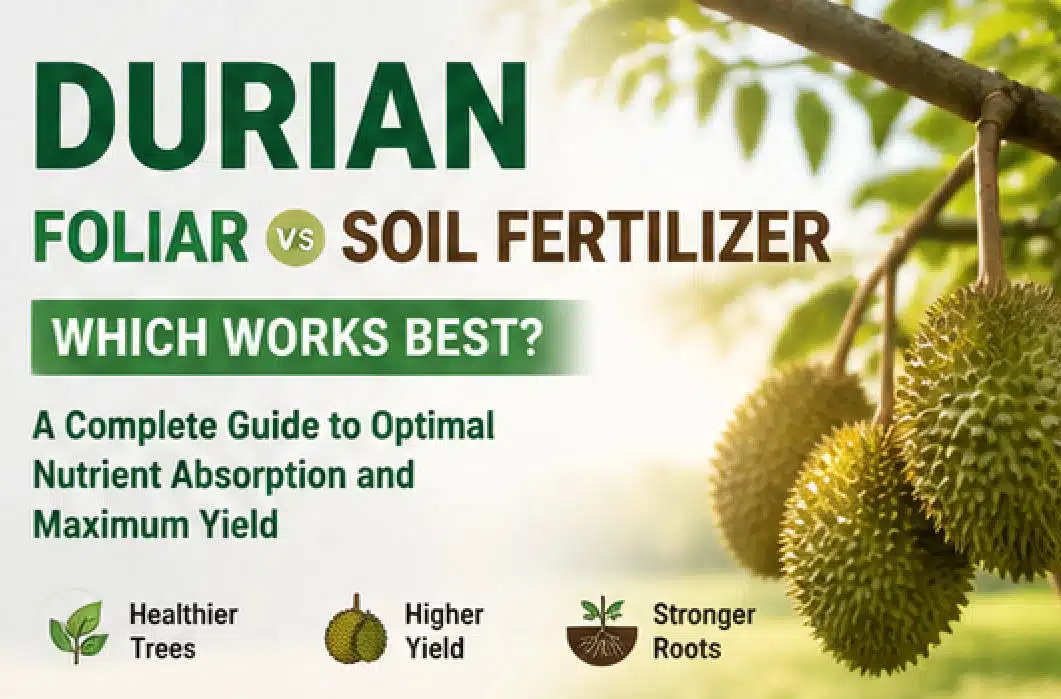
Advantages and Disadvantages of Foliar Feeding
Foliar feeding involves spraying water-soluble fertilizers directly onto leaves, allowing nutrients to be absorbed through the stomata.
Advantages:
- Rapid nutrient absorption: Nutrients applied via leaves bypass the soil, quickly correcting deficiencies.
- Targeted nutrient supply: Ideal for micronutrients like zinc, boron, and magnesium, which may not be readily available in the soil.
- Supplemental feeding: Can be used between soil fertilizations to boost growth or fruit development.
- Reduced nutrient loss: Minimizes leaching in sandy soils or during heavy rainfall.
Disadvantages:
- Limited quantity: Only small amounts of nutrients can be absorbed via leaves, so foliar feeding cannot fully replace soil fertilization.
- Weather-dependent: Rain or high temperatures may reduce effectiveness.
- Frequent applications needed: To maintain consistent nutrition, multiple foliar sprays may be necessary during critical growth stages.
MASL Biotech Solution: Our durian foliar fertilizers are specially formulated for rapid absorption and leaf penetration, ensuring maximum efficiency during flowering and fruit set.

Soil Fertilization: Pros and Cons
Soil fertilization involves applying fertilizers directly to the root zone, allowing nutrients to be absorbed over time.
Pros:
- Sustained nutrient supply: Provides essential macronutrients (NPK) and micronutrients steadily for long-term growth.
- Supports root development: Healthy roots improve water and nutrient uptake, boosting overall tree vigor.
- Cost-effective for large-scale application: Easier to cover extensive orchards compared to repeated foliar sprays.
Cons:
- Slower correction of deficiencies: Symptoms may persist longer because nutrients need time to move from soil to roots.
- Nutrient loss risk: Heavy rain or poor soil structure can cause leaching or reduced availability.
- Inefficient for micronutrients: Some trace elements may bind to soil particles, making them unavailable for immediate uptake.
MASL Biotech Solution: Our durian soil fertilizers are scientifically balanced to deliver the right NPK ratio for each growth stage, ensuring steady nutrient supply while enhancing root health.

Stage-Specific Recommendations for Durian Fertilization
- Early Growth (0–3 years): Focus on soil fertilization with high nitrogen content to promote vegetative growth. Foliar feeding can supplement micronutrients if deficiencies appear.
- Flowering Stage: Foliar feeding is critical for providing boron, zinc, and magnesium to enhance flower quality and fruit set. Minimal nitrogen in soil fertilizer prevents excessive vegetative growth.
- Fruit Development: Balanced NPK soil fertilizers support fruit size and quality, while foliar sprays can correct any micronutrient deficiencies for optimal fruit coloration and taste.
- Mature Trees: Combination of both methods ensures long-term tree health, sustained yield, and high fruit quality.

Tips for Maximizing Nutrient Absorption
- Spray timing: Apply foliar fertilizers during early morning or late afternoon to reduce evaporation and improve leaf absorption.
- Proper dilution: Follow MASL Biotech’s recommended concentrations to avoid leaf burn or nutrient wastage.
- Soil preparation: Ensure proper irrigation and pH management to enhance nutrient availability for roots.
- Rotation: Alternate foliar and soil fertilization according to tree growth stage and observed nutrient deficiencies.
Conclusion: Best Practices for Durian Nutrition
Both foliar feeding and soil fertilization have essential roles in durian nutrition. Foliar feeding provides rapid correction of deficiencies and targeted micronutrient support, while soil fertilization ensures sustained nutrient availability and robust root development. For optimal results, integrating both methods and following stage-specific strategies is key. MASL Biotech offers a full range of fertilizers designed for foliar and soil applications, helping durian farmers achieve higher yields, healthier trees, and premium-quality fruits.
