
Understanding Nutrient Needs in Mid-to-Late Growth Stages
As field crops transition from vegetative growth to reproductive development, their nutritional demands change significantly. During the booting, flowering, pod-setting, and grain-filling stages, crops require not only sufficient macronutrients but also highly efficient micronutrients and metabolic regulators to support yield formation and quality improvement.
Improper fertilization at this stage—either nutrient deficiency or delayed supply—can result in poor grain filling, spikelet degeneration, empty pods, premature senescence, and reduced dry matter accumulation. Therefore, late-stage fertilization should focus on enhancing nutrient utilization efficiency, supporting reproductive organ development, and maintaining metabolic activity until harvest.
Principles of Late-Stage Fertilizer Application
Effective fertilization during later growth stages should follow several core principles:
- Targeted Nutrition
Nutrients must directly support reproductive growth rather than vegetative expansion. Amino acids, chelated micronutrients, and metabolic enhancers are more effective than high doses of conventional nitrogen alone. - High Bioavailability
As root absorption efficiency declines in later stages, nutrients supplied in easily absorbed forms—such as free amino acids and chelated elements—ensure rapid uptake and utilization. - Delayed Senescence
Maintaining green leaf function during grain filling is critical for sustained photosynthesis and assimilate transport to grains or pods. - Stress Mitigation
Late-season environmental stresses (heat, drought, nutrient imbalance) require fertilizers that enhance physiological resilience and metabolic stability.
Role of FieldMax Boost in Late-Stage Crop Nutrition
FieldMax Boost – Field Crops Late Stage Specialty Fertilizer is specifically developed to address the nutritional and physiological needs of crops during mid-to-late growth stages.
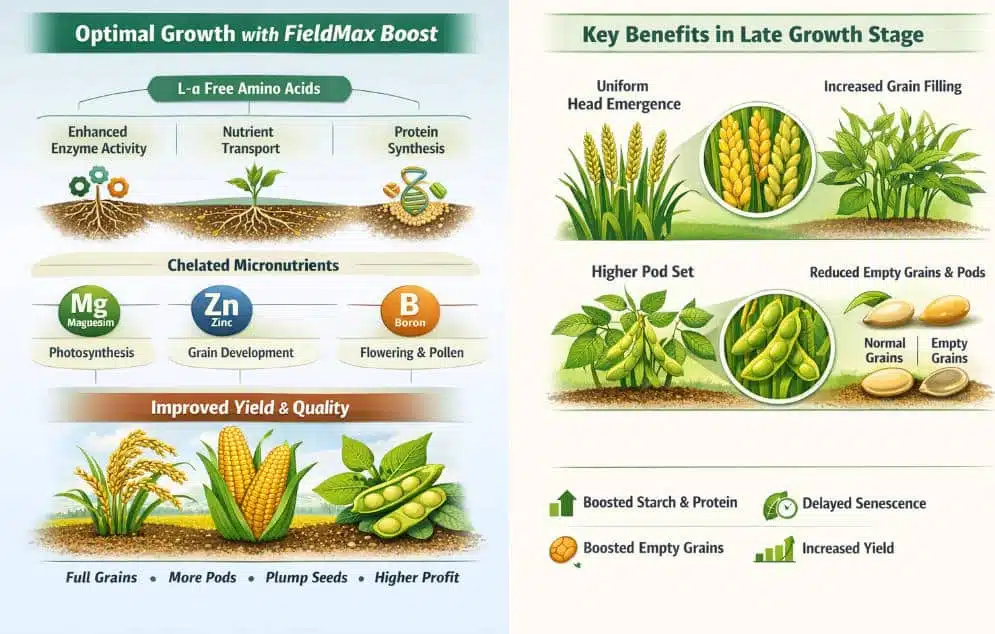
1. L-α Free Amino Acids as the Nutritional Core
FieldMax Boost uses highly active L-α free amino acids, which can be directly absorbed and utilized by crops without additional energy conversion. These amino acids:
- Promote enzyme activity and protein synthesis
- Improve nutrient transport efficiency
- Support reproductive organ development during critical yield-forming stages
2. Chelated Magnesium, Zinc, and Boron for Yield Formation
The scientifically balanced combination of chelated micronutrients plays a crucial role in late-stage crop performance:
- Magnesium (Mg): Enhances chlorophyll stability and photosynthesis efficiency, supporting starch accumulation in grains
- Zinc (Zn): Regulates hormone synthesis and enzyme activation, improving grain setting and development
- Boron (B): Essential for pollen viability, panicle formation, and carbohydrate transport
Chelated forms ensure high stability and absorption, even under challenging soil or climatic conditions.
Application Benefits for Cereal Crops
For cereal crops such as rice, wheat, and corn, FieldMax Boost is particularly effective from the booting stage through grain filling:
- Promotes uniform ear or panicle emergence
- Increases panicle formation rate
- Reduces spikelet degeneration and empty grains
- Enhances starch and protein synthesis
- Improves grain fullness and final yield
By supporting sustained photosynthesis and efficient nutrient translocation, the fertilizer helps maximize yield potential during the most critical reproductive phases.
Advantages for Legume Crops in Late Growth Stages
Legume crops such as soybean, pea, and mung bean also benefit significantly from late-stage nutritional support. When applied from pod setting to grain filling stages, FieldMax Boost:
- Increases pod set rate
- Reduces empty or aborted pods
- Improves grain plumpness and uniformity
- Enhances protein accumulation in seeds
This targeted nutrition ensures legumes maintain active metabolism during seed development, leading to improved yield and market quality.
Vitamin B5: Regulating Late-Stage Metabolism
A key feature of FieldMax Boost is the addition of Vitamin B5 (Pantothenic Acid), which plays a vital role in:
- Regulating late-stage metabolic functions
- Delaying leaf senescence
- Promoting efficient nutrient and assimilate transfer to grains or pods
- Supporting dry matter accumulation during grain filling
By extending the functional lifespan of leaves and vascular tissues, Vitamin B5 helps crops convert photosynthetic products into higher economic yield.
Improving Yield, Quality, and Profitability
Through its synergistic formulation of free amino acids, chelated micronutrients, and metabolic regulators, FieldMax Boost enhances both yield quantity and quality. Crops exhibit better grain filling, higher uniformity, improved nutritional composition, and stronger stress tolerance—ultimately translating into increased profitability for growers.


