
Corn yield and grain quality are largely determined during the mid-to-late growth stages, particularly from tasseling and silking through grain filling and physiological maturity. During this period, corn transitions from vegetative growth to reproductive development, placing high demands on energy supply, micronutrient balance, and stress resistance. Scientific fertilization at this stage is essential to ensure stable pollination, efficient grain filling, and maximum yield potential.
Nutritional Challenges in Mid-to-Late Corn Growth
As corn enters reproductive development, several physiological challenges commonly occur:
- Rapid nutrient translocation from leaves and stems to developing ears
- Increased demand for Magnesium, Zinc, and Boron to support photosynthesis and fertilization
- High sensitivity to heat, drought, and oxidative stress
- Risk of poor kernel set, tip blanking, and reduced thousand-kernel weight
Traditional fertilization strategies often fail to address these complex physiological needs, making targeted late-stage nutrition increasingly important.
Corn Late Stage Specialty Fertilizer: A Precision Solution
Corn Late Stage Specialty Fertilizer is specifically developed for mid-to-late corn growth requirements. It uses highly active L-α free amino acids as the core, scientifically compounded with chelated Magnesium (Mg), Zinc (Zn), and Boron (B), and is uniquely enhanced with Glutathione. This formulation precisely matches corn’s physiological needs from silking through grain filling.
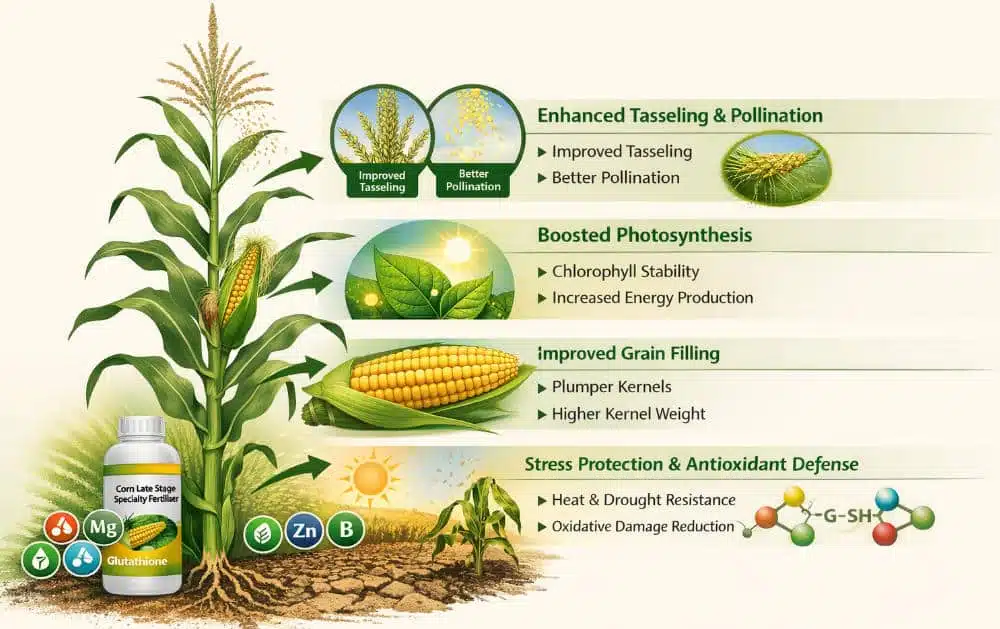
Key Functional Advantages and Agronomic Benefits
1. Promoting Ear Differentiation and Uniform Tasseling
Highly active L-α free amino acids play a crucial role in regulating plant metabolism and protein synthesis. During the reproductive transition:
- They promote ear differentiation and tassel development
- Support uniform tasseling and silking, improving synchronization
- Enhance pollen formation and overall reproductive vigor
This results in improved kernel set and reduced variability within the ear.
2. Sustaining Photosynthesis and Energy Supply During Grain Filling
From silking to grain filling, photosynthesis becomes the primary energy source for kernel development.
- Chelated Magnesium stabilizes chlorophyll structure and maintains high photosynthetic efficiency
- L-α free amino acids activate physiological processes, ensuring sustained leaf function
- Continuous photosynthetic activity provides sufficient carbohydrates for grain filling
This synergy ensures a stable energy supply throughout the critical filling period.
3. Improving Pollination Quality and Kernel Set
Successful fertilization directly determines final yield components.
- Chelated Zinc activates key enzymes such as starch synthase, promoting carbohydrate metabolism
- Boron ensures pollen vitality, pollen tube elongation, and fertilization quality
- Together, Zinc and Boron reduce tip blanking and empty kernels, improving ear fullness
This coordinated micronutrient support enhances both kernel number and kernel uniformity.
4. Enhancing Grain Filling and Thousand-Kernel Weight
During the filling stage, efficient accumulation of starch and protein is essential.
- Zinc-driven enzyme activation improves starch synthesis efficiency
- Balanced Boron nutrition supports nutrient transport to kernels
- Amino acids facilitate protein accumulation, leading to plumper grains
The result is increased thousand-kernel weight and improved grain density.
5. Strengthening Stress Resistance Under Heat and Drought
Late-season corn is often exposed to high temperatures and water stress, which generate reactive oxygen species (ROS).
- Glutathione, with its active sulfhydryl (-SH) groups, precisely scavenges ROS
- Reduces oxidative damage to cell membranes
- Enhances stress tolerance under heat and drought conditions
At the same time, Glutathione regulates endogenous hormones, promoting efficient nutrient translocation from vegetative tissues to developing kernels.
Ensuring Stable Maturation and Yield Improvement
By integrating amino acid nutrition, chelated micronutrients, and antioxidant protection, Corn Late Stage Specialty Fertilizer:
- Ensures stable grain filling and uniform maturity
- Reduces premature leaf senescence
- Improves both yield potential and grain quality
This makes it an ideal nutritional solution for modern, high-yield corn production systems.
Effective fertilization during the later growth stages of corn requires more than basic nutrient supply—it demands precision nutrition aligned with corn physiology. Corn Late Stage Specialty Fertilizer addresses the critical needs of corn from tasseling to maturity, supporting photosynthesis, fertilization, stress resistance, and grain filling. By optimizing kernel set and thousand-kernel weight, it provides a reliable pathway to achieving both higher yields and superior grain quality.


