
The mid-to-late growth stages of soybean—spanning flowering, pod setting, and grain filling—are decisive periods that directly determine final yield, seed quality, and economic return. During these stages, soybeans shift from vegetative growth to reproductive development, requiring precise nutrient management to support high metabolic activity, stable pod retention, and efficient oil and protein accumulation.
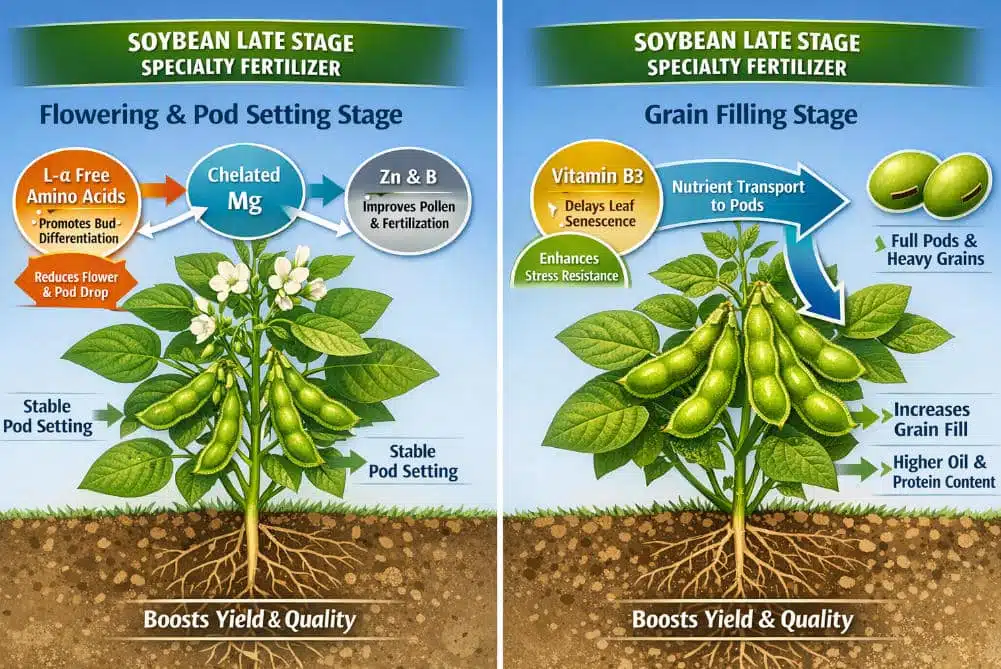
Soybean Late Stage Specialty Fertilizer is specifically formulated to meet these physiological demands. By combining highly active L-α free amino acids, chelated Magnesium (Mg), Zinc (Zn), and Boron (B), along with Vitamin B3, this fertilizer provides targeted nutritional support to ensure stable flowering, strong pod setting, prolonged photosynthetic capacity, and enhanced grain filling efficiency.
Nutritional Challenges in Mid-to-Late Soybean Growth
As soybeans enter reproductive stages, nutrient uptake from soil can become limited due to:
- Declining root activity
- High nutrient competition between vegetative organs and developing pods
- Environmental stresses such as heat, drought, or excessive rainfall
Common late-stage problems include flower and pod drop, poor pollination, incomplete grain filling, reduced hundred-grain weight, and lower oil and protein content. Addressing these challenges requires nutrients that are rapidly absorbed, highly bioavailable, and physiologically compatible with soybean metabolism.
Core Technology: Highly Active L-α Free Amino Acids
L-α free amino acids serve as the metabolic foundation of Soybean Late Stage Specialty Fertilizer. Unlike protein-derived or inactive amino forms, L-α free amino acids are directly absorbed and utilized by plant cells.
Key Benefits:
- Promote flower bud differentiation and reproductive organ development
- Stabilize pod setting, significantly reducing flower and pod abortion
- Act as natural chelating agents, enhancing micronutrient absorption
- Improve stress tolerance by regulating osmotic balance and enzyme activity
During grain filling, these amino acids ensure a steady supply of energy and carbon skeletons, supporting continuous dry matter accumulation in developing seeds.
Synergistic Role of Chelated Magnesium: Enhancing Photosynthesis
Magnesium is the central atom of the chlorophyll molecule and is critical for carbohydrate synthesis and transport.
In this formulation:
- Chelated Magnesium works synergistically with L-α free amino acids
- Enhances photosynthetic efficiency during peak reproductive demand
- Supports ATP formation and carbohydrate translocation from leaves to pods
This synergy ensures sustained photosynthate supply, preventing premature leaf yellowing and supporting uniform grain filling.
Zinc and Boron: Ensuring Fertilization Quality and Seed Formation
Chelated Zinc (Zn)
Zinc plays a vital role in:
- Activating protein synthase enzymes
- Regulating hormone balance
- Promoting amino acid and protein synthesis in developing grains
Adequate zinc availability enhances seed protein accumulation and improves overall seed vigor.
Boron (B)
Boron is essential for:
- Pollen viability and pollen tube elongation
- Cell wall integrity during seed development
- Efficient fertilization and embryo formation
When zinc and boron work together, they significantly:
- Reduce blighted grain rate
- Improve fertilization success
- Promote full pod formation and uniform seed size
Vitamin B3: Sustaining Metabolic Activity and Stress Resistance
The addition of Vitamin B3 (Niacin) provides advanced physiological support during late growth stages.
Functional Advantages:
- Improves photosynthetic efficiency and energy metabolism
- Delays functional leaf senescence, extending the photosynthetically active period
- Enhances stress resistance under heat, drought, or nutrient imbalance
- Maintains activity of key metabolic enzymes involved in oil and protein synthesis
By sustaining leaf function and metabolic stability, Vitamin B3 helps maintain nutrient flow to pods during critical grain filling stages.
Directional Nutrient Transport for Yield and Quality Enhancement
A defining advantage of Soybean Late Stage Specialty Fertilizer is its ability to promote directional nutrient transport:
- Nutrients are preferentially allocated from leaves and stems to developing pods
- Enhances oil and protein accumulation efficiency
- Increases hundred-grain weight and overall yield stability
This targeted nutrient movement ensures that reproductive organs receive priority nutrition, even under suboptimal environmental conditions.
Application Recommendations
- Application stage: Early flowering to early grain filling
- Method: Foliar spray or fertigation (depending on cultivation system)
- Frequency: 1–2 applications during reproductive stages
- Compatibility: Compatible with most crop protection products (jar test recommended)
Effective fertilization during the later growth stages of soybean is essential for maximizing yield potential and grain quality. Soybean Late Stage Specialty Fertilizer, with its scientifically balanced combination of L-α free amino acids, chelated Magnesium, Zinc, Boron, and Vitamin B3, provides comprehensive nutritional support tailored to the physiological needs of flowering, pod setting, and grain filling.
By stabilizing reproductive development, enhancing photosynthetic efficiency, improving fertilization quality, and promoting efficient nutrient transport to pods, this specialty fertilizer delivers full pods, higher hundred-grain weight, improved oil and protein content, and increased overall productivity—making it an ideal solution for high-performance soybean production.


