
Early-stage crop development is a decisive phase that determines final yield, fruit uniformity, and stress resilience. In modern precision agriculture, growers are increasingly turning to biostimulant-based early-stage fertilizers that combine amino acids, micronutrients, and metabolic activators.
Among these, the synergy between L-α free amino acids and Vitamin B1 (Thiamine) has emerged as a powerful strategy to enhance root establishment, nutrient uptake efficiency, and stress tolerance in vegetables and fruit crops.
This article provides a technical breakdown of how these components interact at the physiological and biochemical levels—and why this synergy is critical for early-stage crop success.
1. Why Early Growth Stage Nutrition Is Critical
During the seedling to early vegetative phase, plants undergo:
- Rapid cell division and differentiation
- Initial root architecture formation
- Activation of photosynthetic systems
- Establishment of metabolic pathways
At this stage, any limitation in nutrient availability or environmental stress (cold soil, drought, transplant shock) can result in:
- Weak root systems
- Uneven plant growth
- Reduced nutrient assimilation
- Lower final yield potential
This is why early-stage specialty fertilizers for vegetables and fruits are designed to deliver highly bioavailable and metabolically active compounds.
2. L-α Free Amino Acids: The Metabolic Engine
Unlike synthetic or DL-form amino acids, L-α amino acids are directly usable in plant metabolism.
Key Functions:
1. Energy Metabolism Activation
L-α amino acids act as precursors in key metabolic pathways such as:
- Krebs cycle intermediates
- Protein biosynthesis
- Enzyme activation
This reduces the plant’s energy cost for nitrogen assimilation, allowing more energy to be allocated to growth and root expansion.
2. Root System Development
They stimulate:
- Root meristem activity
- Lateral root formation
- Root hair density
This directly improves nutrient uptake efficiency in early-stage crops.
3. Chelation & Nutrient Transport
Amino acids function as natural chelators, enhancing the mobility of:
- Zinc (Zn)
- Magnesium (Mg)
- Boron (B)
This supports balanced micronutrient delivery in vegetable seedlings.
3. Vitamin B1 (Thiamine): The Stress Resistance Regulator
Vitamin B1 plays a critical role in plant stress physiology and metabolic signaling.
Core Benefits:
1. Enhanced Stress Tolerance
Vitamin B1 activates plant defense pathways that mitigate:
- Low temperature stress
- Drought conditions
- Soil-borne pathogen pressure
This is particularly important in early transplant stages of vegetables and fruits.
2. Improved Carbohydrate Metabolism
Thiamine acts as a cofactor in enzymatic reactions linked to:
- Sugar metabolism
- Energy transfer
This ensures a stable energy supply during rapid early growth.
3. Root Recovery & Transplant Shock Reduction
Vitamin B1 supports:
- Faster root regeneration
- Reduced transplant shock symptoms
Making it essential for greenhouse vegetable production and open-field transplanting systems.

4. Synergistic Mechanism: Why L-α Amino Acids + Vitamin B1 Work Better Together
When combined, these two components create a multi-layered physiological enhancement system:
4.1 Energy + Protection Dual Pathway
- L-α amino acids → Boost metabolic activity
- Vitamin B1 → Protect metabolic processes under stress
4.2 Root Expansion + Stress Shielding
- Amino acids stimulate root growth
- Vitamin B1 ensures roots remain functional under adverse conditions
4.3 Nutrient Uptake + Utilization Efficiency
- Amino acids enhance nutrient transport
- Vitamin B1 improves metabolic conversion efficiency
This synergy leads to:
- Faster establishment of seedlings
- Uniform crop growth
- Higher resilience in unstable environments
5. Role of Chelated Micronutrients in the System
A complete early-stage formulation should also include:
Chelated Zinc (Zn)
- Promotes auxin synthesis
- Enhances cell division in meristematic tissues
Chelated Boron (B)
- Critical for cell wall formation
- Improves flower initiation potential
Magnesium (Mg)
- Central atom of chlorophyll
- Directly impacts photosynthetic efficiency in young leaves
Together with amino acids and Vitamin B1, these nutrients create a high-efficiency early-stage plant nutrition system.
6. Practical Application in Vegetable & Fruit Crops
This synergistic approach is especially effective in:
- Tomatoes, peppers, cucumbers (greenhouse vegetables)
- Leafy greens during seedling establishment
- Strawberries and berries in early root development
- Fruit trees during early vegetative flush
Key Outcomes Observed:
- Faster root establishment
- More uniform plant growth
- Higher chlorophyll content
- Reduced stress symptoms
- Improved early vigor
7. Product Integration: A Practical Example
A formulation such as VegMax Vigor – Vegetable & Fruit Early Stage Specialty Fertilizer (MSAL) integrates:
- High-purity L-α free amino acids
- Active Vitamin B1
- Chelated Zn, B, Mg
This type of amino acid-based early-stage fertilizer for vegetables and fruits is designed to:
- Accelerate early vegetative growth
- Enhance nutrient uptake efficiency
- Improve stress resistance under variable field conditions
Importantly, such formulations are aligned with the trend toward sustainable, bio-based crop nutrition solutions.
8. Field Application Guidelines: From Theory to Practice
To translate the biochemical advantages of L-α amino acids and Vitamin B1 into measurable field performance, application strategy is critical. Below are practical, experience-driven recommendations based on common vegetable and fruit production systems.
8.1 Suitable Crops & Scenarios
This type of amino acid + Vitamin B1 early-stage fertilizer is especially suitable for:
Vegetable Crops
- Solanaceae: tomato, pepper, eggplant
- Cucurbitaceae: cucumber, melon, zucchini
- Leafy greens: lettuce, spinach, kale
Fruit Crops
- Berries: strawberry, blueberry
- Young fruit trees: citrus, apple, grape (early vegetative stage)
High-Value Scenarios
- Transplanting stage (greenhouse → open field)
- Low-temperature early spring planting
- Poor soil structure or weak root zones
- Continuous cropping systems (soil fatigue conditions)
8.2 Recommended Application Methods
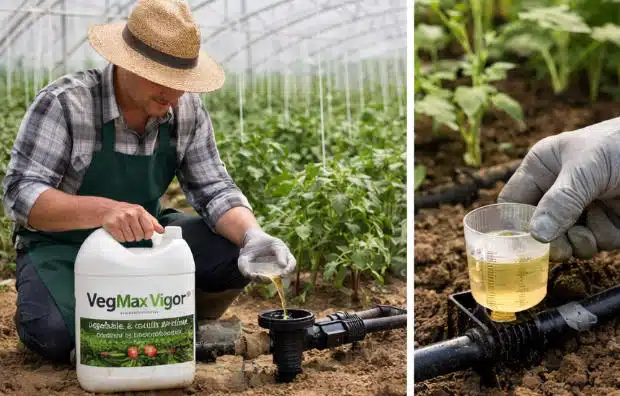
1. Root Irrigation / Drip Fertigation (Primary Method)
- Ensures direct delivery to root zone
- Maximizes amino acid absorption and micronutrient uptake
Recommended dilution ratio:
- 800–1200× dilution
Application frequency:
- Every 7–10 days during early growth stage
2. Foliar Spray (Supplementary)
- Rapid correction of nutrient imbalance
- Useful under stress conditions
Recommended dilution ratio:
- 1000–1500× dilution
Best timing:
- Early morning or late afternoon
- Avoid strong sunlight to prevent leaf burn
3. Transplant Dipping (High-Effect Use Case)
- Seedling roots soaked before transplanting
Dilution ratio:
- 1000×
Soaking time:
- 5–10 minutes
Benefit:
- Significantly reduces transplant shock
- Promotes faster root establishment
8.3 Water Quality & Temperature Considerations
Water Quality
- Use clean water with low salinity (EC < 0.5 preferred)
- Avoid mixing with highly alkaline solutions
- Compatible with most fertilizers, but avoid strong chemical reactions (e.g., high copper content)
Temperature Conditions
- Optimal application temperature: 15°C – 30°C (59°F – 86°F)
- Below 10°C: absorption slows, effect may be delayed
- Above 35°C: risk of evaporation and reduced efficiency
8.4 Common Mistakes & Failure Factors
Even highly efficient formulations can underperform if misapplied.
1. Overconcentration
- Excessive dosage may cause:
- Osmotic stress
- Leaf burn (in foliar application)
2. Incorrect Timing
- Applying during:
- Midday heat
- Heavy rainfall
→ reduces absorption efficiency
3. Ignoring Soil Conditions
- Compacted or waterlogged soil limits:
- Root respiration
- Nutrient uptake
4. One-Time Use Expectation
- Biostimulants require continuous, staged application
- Single application ≠ sustained effect
5. Mixing Incompatibility
- Avoid mixing with:
- Strong alkaline pesticides
- High-metal ion formulations
8.5 Stage-Based Application Strategy (Recommended Program)
| Growth Stage | Key Objective | Recommended Strategy |
|---|---|---|
| Seedling Stage | Root initiation | Root irrigation (1000×), once every 7 days |
| Post-Transplant (0–10d) | Stress recovery | Root + foliar combination |
| Early Vegetative | Rapid growth & leaf expansion | Continuous fertigation |
| Pre-Flower Initiation | Nutrient accumulation | Maintain stable application interval |
This staged approach ensures:
- Consistent metabolic activation
- Stable root system expansion
- Reduced growth variability across crops
8.6 Observable Field Results (What Growers Typically See)
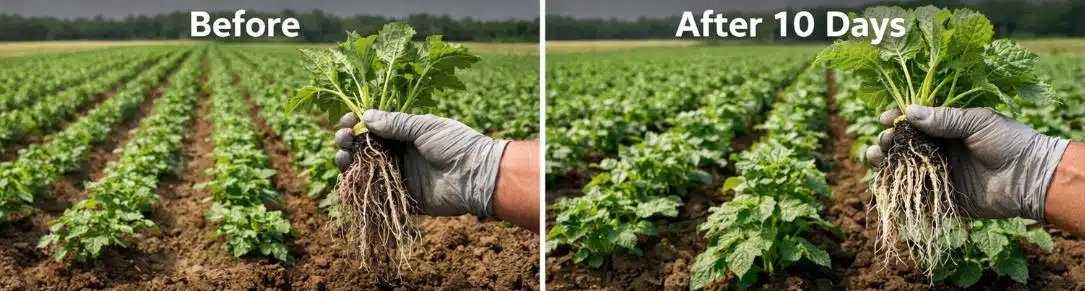
Within 5–10 days after application:
- Increased root density and whiteness
- Faster new leaf emergence
- Improved leaf thickness and color (higher chlorophyll)
- Reduced wilting under mild stress
Within 2–3 weeks:
- More uniform plant size
- Stronger stem structure
- Enhanced early vigor
The combination of L-α amino acids and Vitamin B1 represents a scientifically grounded approach to improving early-stage crop performance.
By simultaneously addressing:
- Metabolic activation
- Root system development
- Stress resistance
- Nutrient efficiency
this synergy provides a strong physiological foundation for high yield, quality fruit development, and uniform crop performance.
For growers aiming to optimize early-stage outcomes, adopting biostimulant-enhanced fertilizer strategies is no longer optional—it is a competitive necessity.
