
In early crop growth, most growers judge success by what they can see — greener leaves, faster growth, stronger stems. But in reality, the most decisive changes happen underground and at the cellular level, long before visible differences appear.
This is exactly why early-stage nutrition is no longer just about “feeding nitrogen.” It is about how efficiently the plant builds its internal system — roots, metabolism, and stress response.
Among the more effective approaches today is combining L-α amino acids with vitamin B1, especially in an early stage specialty fertilizer for vegetables and fruits.
Not all early-stage fertilizers work the same
Many growers assume that all early-stage fertilizers perform similarly. In practice, the gap can be significant — especially between conventional mineral feeding and biologically active formulations.
Here is a simplified comparison that reflects what actually happens in the field:
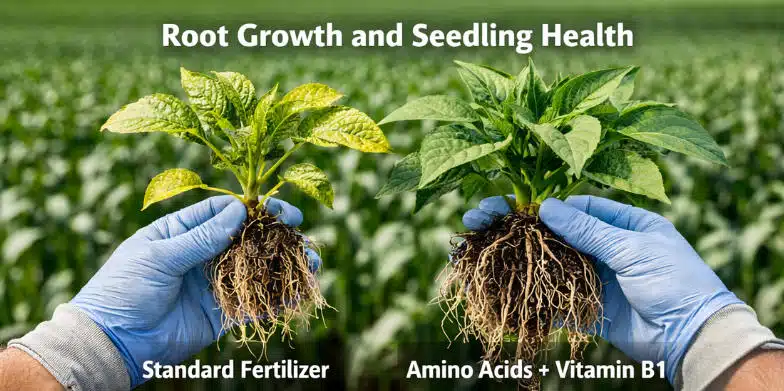
Conventional Fertilizer vs Amino Acid-Based Early Nutrition
| Aspect | Conventional Mineral Fertilizer | Amino Acid-Based Early Stage Fertilizer |
|---|---|---|
| Nutrient Form | Inorganic salts | Organic L-α amino acids + chelated nutrients |
| Absorption Speed | Depends on soil conditions | Faster, more direct uptake |
| Root Development | Passive response | Actively stimulated |
| Stress Resistance | Limited | Enhanced via metabolic support |
| Growth Uniformity | Often uneven | More consistent and stable |
| Recovery After Stress | Slow | Faster recovery |
This difference explains why growers searching for root development fertilizer or seedling vigor fertilizer are increasingly shifting toward amino acid-based solutions.
What L-α amino acids actually change inside the plant
L-α amino acids are not just nutrients — they function more like metabolic activators.
They directly influence how the plant allocates energy during early growth.
A practical comparison: Nitrogen vs Amino Acids
| Function | Traditional Nitrogen Supply | L-α Amino Acids |
|---|---|---|
| Energy Requirement | High (needs conversion) | Low (ready-to-use form) |
| Metabolic Efficiency | Moderate | High |
| Root Stimulation | Indirect | Direct |
| Stress Recovery | Weak | Strong |
| Compatibility with Micronutrients | Limited | Strong synergy |
In simple terms, amino acids reduce the “workload” of the plant. Instead of spending energy converting nutrients, the plant can invest that energy into root expansion and early biomass formation.
Vitamin B1: the missing piece in stress management
If amino acids drive growth, vitamin B1 stabilizes it.
Many growers only realize the importance of vitamin B1 after encountering stress problems — transplant shock, cold weather, or drought. But its real value lies in prevention rather than correction.
With vs Without Vitamin B1 Under Stress Conditions
| Condition | Without Vitamin B1 | With Vitamin B1 |
|---|---|---|
| Low Temperature | Slowed metabolism | Maintained metabolic activity |
| Drought | Root slowdown | Better root resilience |
| Transplant Shock | Growth stagnation | Faster recovery |
| Disease Pressure | Higher sensitivity | Improved tolerance |
This is why vitamin B1 is often included in stress tolerance fertilizer for crops — not to boost growth directly, but to protect growth continuity.
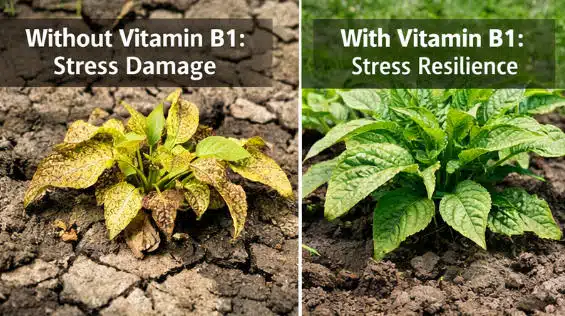
Why amino acids + vitamin B1 is a smarter combination
Individually, both components are useful. Together, they solve a more complex problem: how to grow fast without becoming fragile.
- Amino acids push growth forward
- Vitamin B1 prevents growth from collapsing under stress
This creates a balance that is often missing in standard fertilization programs.
Growth Strategy Comparison
| Strategy | Result |
|---|---|
| Fast growth without protection | High risk, unstable seedlings |
| Stress protection without nutrition | Slow, weak development |
| Amino acids + Vitamin B1 | Balanced, resilient growth |
This balance is especially important for vegetable and fruit crops, where early inconsistency often leads to uneven flowering and fruit development later.
The role of chelated magnesium, zinc, and boron (and why form matters)
Micronutrients are often present in fertilizers — but their effectiveness depends heavily on their form.
Chelated vs Non-chelated Micronutrients
| Aspect | Non-chelated Form | Chelated Form |
|---|---|---|
| Stability in Soil | Low | High |
| Availability to Roots | Easily fixed | Readily available |
| Absorption Efficiency | Inconsistent | Stable |
| Impact on Early Growth | Limited | Strong |
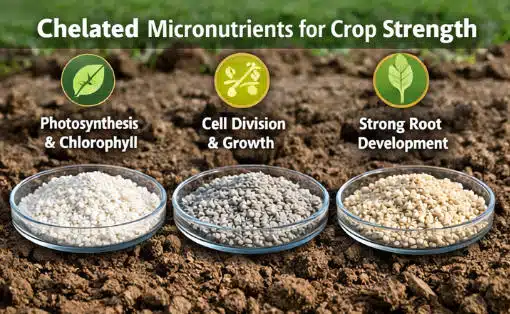
- Magnesium supports chlorophyll and photosynthesis
- Zinc drives enzyme activity and cell division
- Boron ensures meristem development and structural growth
When combined with amino acids, these micronutrients become more than supplements — they become part of a coordinated growth system.
What this means in real growing conditions
When this type of formulation is applied correctly, the differences are not subtle.
Field-Level Comparison: Standard Program vs Optimized Early Nutrition
| Indicator | Standard Fertilization | Optimized Early Nutrition |
|---|---|---|
| Seedling Uniformity | Variable | High |
| Root Density | Moderate | Dense and active |
| Leaf Color | Uneven green | Deep, consistent green |
| Stress Recovery | Slow | Rapid |
| Growth Continuity | Interrupted | Stable |
This is why growers looking for vegetable and fruit crop early stage nutrition solutions are paying more attention to formulation logic rather than just nutrient content.
Why early-stage decisions affect final yield more than expected
There is a pattern experienced growers recognize:
Weak start → uneven growth → inconsistent flowering → variable fruit quality
Strong start → uniform plants → stable flowering → consistent yield
The early stage is not just a phase. It is a blueprint.
A well-developed root system and stable metabolism at this stage often lead to:
- better fruit uniformity
- improved skin texture
- stronger plant endurance
- higher overall yield consistency
Where VegMax Vigor fits into this framework
MSAL VegMax Vigor – Vegetable & Fruit Early Stage Specialty Fertilizer is built around this exact logic.
Instead of focusing on a single nutrient, it combines:
- L-α free amino acids (metabolic driver)
- Vitamin B1 (stress stabilizer)
- Chelated Mg, Zn, B (structural and physiological support)
Its purpose is not to force rapid growth, but to build a stable, efficient, and resilient plant system from the beginning.
In early-stage crop management, the question is not how fast a plant grows in the first week. The real question is: Can that growth continue under pressure?
The combination of L-α amino acids and vitamin B1 offers a practical answer — not by pushing the plant harder, but by making it stronger where it matters most.
Optional FAQ Section
1. What is the main benefit of L-α amino acids in crop nutrition?
They help support energy metabolism, improve nutrient use efficiency, and encourage root expansion during early growth.
2. Why is vitamin B1 important for plants?
Vitamin B1 helps strengthen stress resistance signaling and supports stable plant growth under low temperature, drought, or transplant stress.
3. Why combine amino acids with chelated micronutrients?
Because amino acids support metabolism while micronutrients like magnesium, zinc, and boron support chlorophyll synthesis, cell division, and meristem development.
4. Is this type of fertilizer suitable for vegetables and fruit crops?
Yes. It is especially suitable for early-to-mid growth stages when seedling vigor, root development, and nutrient accumulation are most important.
