
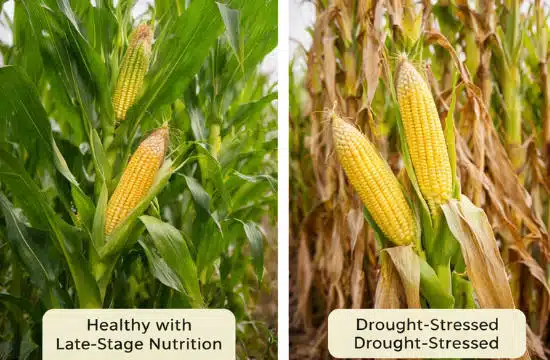
From tasseling to grain filling, the plant is no longer building structure—it is trying to protect photosynthesis, maintain metabolic activity, and push assimilates into kernels. When heat and drought hit during this window, the result is not always visible immediately. Instead, it shows up later as poor kernel set, tip blanking, and low thousand-kernel weight.
This is exactly why more growers are searching for solutions like corn tasseling stage fertilizer solution or best fertilizer for corn grain filling stage. What they are really asking is:
Why does traditional fertilization stop working when the crop needs it most?
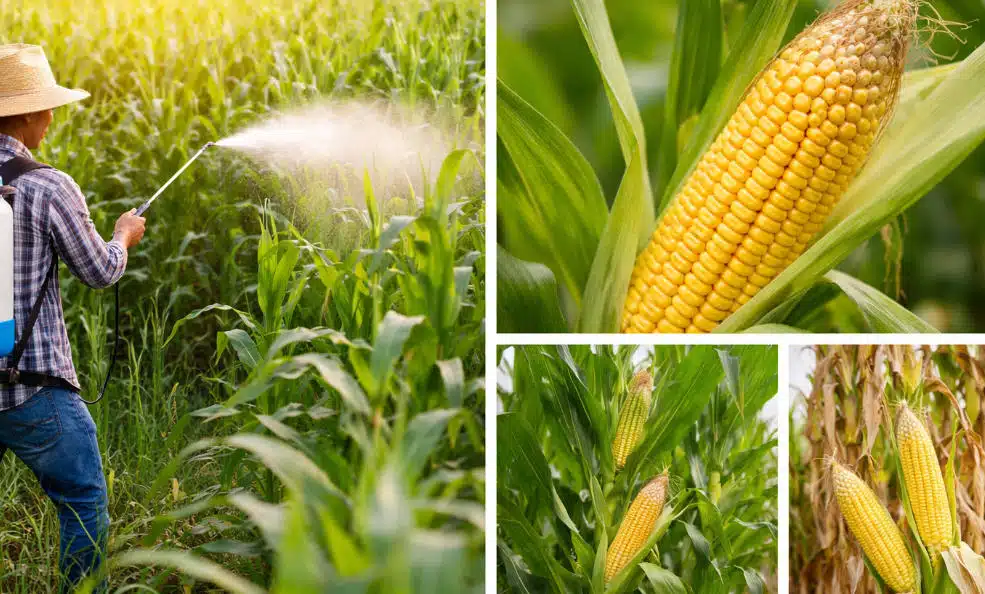
Conventional Fertilizer vs Late-Stage Functional Nutrition
At mid-to-late stages, the limitation is no longer “nutrient supply” — it is physiological efficiency.
Here is where the difference becomes clear:
| Dimension | Conventional Fertilizer (NPK / Basic Micronutrients) | MSAL Corn Late Stage Specialty Fertilizer |
|---|---|---|
| Core Function | Nutrient supply | Physiological regulation + nutrient utilization |
| Under Heat Stress | Photosynthesis declines rapidly | Maintains metabolic activity via amino acids |
| Under Drought | Nutrient uptake limited by roots | Foliar + bioactive support improves resilience |
| Kernel Set | Often unstable | Improved via Zn + B + amino acid synergy |
| Grain Filling | Dependent on remaining leaf function | Actively supported (energy + transport + enzyme activation) |
| Stress Defense | Weak | Glutathione-driven ROS scavenging |
The key difference is simple:
Traditional fertilizers feed the plant.
Late-stage functional nutrition helps the plant survive and finish the job.
Why L-α Amino Acids Change the Equation
L-α free amino acids are not just nutrients—they are ready-to-use metabolic building blocks.
Under stress conditions, plants normally spend energy synthesizing amino acids internally. When you supply them externally, you reduce that metabolic burden. The plant can redirect energy toward survival and grain development.
But the more interesting effect shows up in late-stage corn:
- Supports tassel development and synchronization
- Improves silking uniformity
- Enhances nutrient transport toward ears
- Stabilizes metabolic activity during stress
This is why amino acid fertilizer for corn is increasingly used not at early growth stages, but specifically during reproductive stages.
Glutathione vs Standard “Anti-Stress” Products
Many products claim “stress resistance.” Few actually address oxidative damage at the cellular level.
Here is a more realistic comparison:
| Stress Response Factor | Typical Anti-Stress Products | Glutathione-Based Approach |
|---|---|---|
| Mode of Action | Hormone stimulation / general tonics | Direct ROS scavenging (-SH groups) |
| Speed of Response | Moderate | Rapid biochemical response |
| Cell Membrane Protection | Limited | Strong protection against oxidative damage |
| Hormone Regulation | Indirect | Direct involvement in signaling pathways |
| Effect on Grain Filling | Weak linkage | Supports sustained filling under stress |
Glutathione works differently. Its sulfhydryl (-SH) groups directly neutralize reactive oxygen species (ROS), which accumulate rapidly under high temperature and drought.
In simple terms:
- Heat + drought → ROS accumulation → cell damage → reduced grain filling
- Glutathione → ROS neutralization → preserved cell function → stable grain filling
This is why combining glutathione biostimulant for corn with amino acids creates a much more complete stress-response system.
Micronutrients: Small Elements, Big Consequences
Late-stage failures in corn are often blamed on “weather,” but in many cases, micronutrient inefficiency is part of the problem.
Let’s break it down:
| Element | Role in Late-Stage Corn | What Happens If It’s Missing |
|---|---|---|
| Magnesium (Mg) | Maintains chlorophyll & photosynthesis | Early leaf senescence, weak energy supply |
| Zinc (Zn) | Activates enzymes (e.g., starch synthase) | Poor starch accumulation |
| Boron (B) | Pollen viability & fertilization | Tip blanking, empty kernels |
Now compare two scenarios:
Scenario A: Standard Nutrition
- Leaves lose activity faster under stress
- Pollination is inconsistent
- Grain filling slows prematurely
Scenario B: Functional Late-Stage Formula (MSAL approach)
- Chlorophyll stays active longer
- Pollination quality improves
- Assimilates continue moving into kernels
The difference is not dramatic at first glance.
But at harvest, it shows up clearly—in kernel density, uniformity, and weight.
Why This “Dual Engine” Model Works
If you step back, the logic becomes very clear:
- Amino acids → keep metabolism running
- Glutathione → protect cells from stress damage
- Micronutrients → ensure grain formation and filling actually happen
Most products focus on one of these.
Very few combine all three in a stage-specific way.
That is why this can be described as a “stress resistance + grain filling” dual engine.
A More Practical Way to Think About Late-Stage Fertilization
Farmers don’t think in biochemical terms. They think in outcomes. So let’s simplify everything into one real-world comparison:
| Question | Without Late-Stage Support | With Targeted Late-Stage Nutrition |
|---|---|---|
| Will tasseling be uniform? | Not always | More consistent |
| Will pollination succeed under heat? | Risky | More stable |
| Will kernels fill completely? | Often incomplete | More uniform filling |
| Final yield | Uncertain | More predictable |
| Grain quality | Variable | More consistent |
That is why interest in corn grain filling fertilizer and drought recovery fertilizer for corn keeps increasing. Growers are no longer satisfied with “good early growth.” They want a strong finish.
Late-stage corn management is not about adding more fertilizer. It is about helping the plant stay functional long enough to finish yield formation.
MSAL’s Corn Late Stage Specialty Fertilizer fits into this shift—not as a high-input solution, but as a precision-stage intervention. And from a technical standpoint, the combination makes sense:
- L-α amino acids reduce metabolic pressure
- Glutathione protects against oxidative stress
- Chelated Mg, Zn, and B ensure grain formation is not compromised
Individually, each component has value. Together, they address the exact moment when yield is decided.
