
Wheat yield is rarely decided at sowing. In practice, the final result is often shaped during heading, flowering, and grain filling, when the crop decides how much of its potential will actually be converted into plump, well-filled kernels. Research on wheat grain filling shows that extended flag leaf photosynthesis alone does not guarantee higher yield; grain filling capacity matters just as much, and late-stage starch synthesis can become a limiting factor. That is exactly why late-stage nutrition deserves a different way of thinking. It is not about “more fertilizer.” It is about better timing, better delivery, and better physiological support.
This is also the logic behind MASL’s crop-stage-specific approach. The company positions itself as a high-tech agricultural fertilizer manufacturer focused on innovative crop nutrition solutions, and its product line includes field-crop formulations designed around specific growth stages. That matters for growers searching for terms like late-stage wheat fertilizer, wheat grain filling fertilizer, or foliar nutrition for wheat grain filling because wheat does not need the same input profile throughout the entire season.
Why late-stage wheat is a different battlefield
Once wheat enters flowering and grain filling, the crop shifts from building biomass to moving energy into the grain. At that point, photosynthesis, nutrient transport, pollen vitality, and enzyme activity all become tightly linked. Heat stress can shorten grain filling and reduce yield, while higher temperatures during post-anthesis stages can lower photosynthetic performance. Magnesium is especially relevant here because it supports Rubisco activation and helps stabilize photosynthesis under high-temperature stress during wheat grain filling.
That is why a product formulated for Wheat Yield – Wheat Late Stage Specialty Fertilizer should be read as a reproductive-stage tool, not a general-purpose feed. A good late-stage formula is trying to protect the source-sink relationship: keep the canopy active, keep assimilate moving, and keep the developing grain supplied when it needs it most. In practical language, growers often look for this through searches like best foliar spray for wheat grain filling, wheat thousand kernel weight fertilizer, and wheat late season nutrition.
Zinc and boron are important, but they are only part of the story
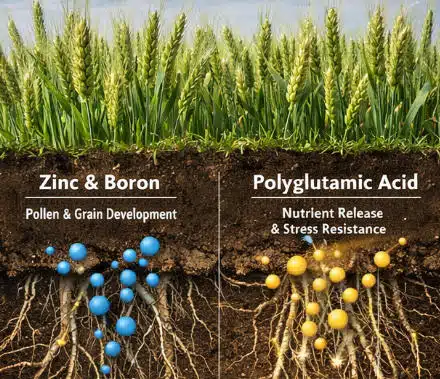
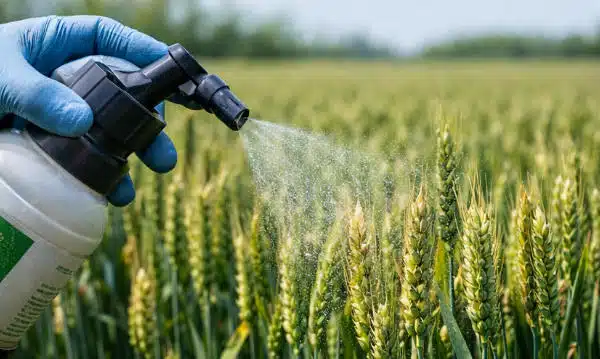
Zinc and boron are classic late-stage wheat nutrients for a reason. Zinc is involved in enzyme systems linked to protein synthesis, hormone regulation, carbohydrate metabolism, starch synthesis, photosynthesis, and seed and pollen formation. Foliar zinc applications during later growth stages are widely discussed in wheat biofortification research because they can improve grain zinc accumulation and support grain development.
Boron is just as critical at the reproductive stage. In wheat, boron deficiency affects male and female reproductive organs, weakens pollen development, and can lead to fertilization failure and poor grain set. In other words, boron is not only a “micronutrient.” It is part of the machinery that keeps florets alive and productive. For growers, that is the difference between a head that fills well and a head that leaves behind empty grains.
That is why a technically strong wheat formulation often aims at more than one function at once: support pollen vitality, improve fertilization quality, reduce floret degeneration, and strengthen starch accumulation. Those are the kinds of benefits growers are really looking for when they search for wheat flowering to grain filling fertilizer, wheat grain setting nutrition, or high thousand kernel weight fertilizer.
Where polyglutamic acid changes the equation
Polyglutamic acid is interesting because it plays a different role from conventional micronutrients. It is not there simply to “feed” the crop. It can act more like a delivery and retention support layer. In wheat field experiments, γ-polyglutamic acid improved yield, nitrogen recovery efficiency, and soil microbial nitrogen dynamics; the study also showed that more mineral nitrogen was immobilized early and then gradually released later in the growth cycle. That is exactly the kind of behavior you want in a late-stage nutrition strategy.
This is where the phrase nutrient-release carrier becomes technically useful. A carrier effect matters because grain filling is a time-sensitive process. If nutrients disappear too fast, the crop misses them when they are needed. If they are held and released more evenly, the plant can continue to feed the grain over a longer window. That is why polyglutamic acid is often discussed alongside terms like slow-release nutrient support, fertilizer synergist, and nutrient use efficiency fertilizer. In wheat, that is not marketing language; it is a practical way to think about late-season feeding.
Polyglutamic acid may also help the crop tolerate late-season stress. Wheat research on γ-PGA shows that exogenous application can alleviate salt stress, and other studies in different crops report improved drought resistance and better plant stress responses. For wheat growers dealing with dry hot wind, high temperature, or erratic moisture during grain filling, this is important because stress at this stage can reduce photosynthetic duration, accelerate senescence, and cut final kernel weight.
The real value is the combination
The strength of a late-stage wheat formula is not the presence of one “hero ingredient.” It is the way the ingredients work together. L-α amino acids can support metabolic activity, chelated magnesium can help maintain chlorophyll function and photosynthetic stability, zinc can support enzyme activity and grain development, boron can protect fertilization and grain set, and polyglutamic acid can help smooth nutrient availability through the grain-filling window. That kind of synergy is much more aligned with how wheat actually fills grain in the field.
In MASL’s own wheat content, the company emphasizes that its late-stage wheat product is designed for mid-to-late growth needs, with highly active L-α free amino acids, chelated micronutrients, and polyglutamic acid supporting ear differentiation, uniform ear emergence, chlorophyll stability, photosynthetic efficiency, and grain filling. That positioning fits the technical reality: the goal is not just greener leaves, but better kernel formation, better filling, and better final yield quality.
What growers should really look for
When evaluating a wheat late-stage specialty fertilizer, I would not start with the label slogan. I would start with the agronomic question: does this product help the crop at the exact moment when sink strength, assimilate supply, and stress resistance are all under pressure? If the answer is yes, then the formulation is doing useful work. If it can also reduce nutrient loss, support late nitrogen efficiency, and protect grain filling under heat or drought stress, then it has real field value.
That is why I see polyglutamic acid as more than an additive. In a late-stage wheat program, it can function as the quiet part of the formulation that makes the rest of the nutrients perform better. Zinc and boron may get the attention. Magnesium may keep the canopy alive. But polyglutamic acid is what helps the system stay steady long enough for the grain to finish properly. For growers focused on wheat yield improvement, wheat grain filling support, and yield and quality improvement in wheat, that is not a minor detail. It is the difference between a crop that looks good and a crop that actually pays.
