
Wheat yield is rarely decided at sowing. The real battle happens later—between heading and grain filling—when plants either convert energy into dense, heavy kernels or fall short with shriveled grains and yield loss.
After years of observing wheat nutrition strategies across different regions, one thing becomes clear: late-stage nutrition is often underestimated, yet it has the most direct impact on thousand-kernel weight and final yield quality.
This is where targeted solutions like Wheat Yield – Wheat Late Stage Specialty Fertilizer come into play—not as a generic nutrient input, but as a physiological regulator working in sync with the crop.
Why the Late Growth Stage Determines Wheat Yield
From spike differentiation to grain filling, wheat enters a metabolically demanding phase. The plant must:
- Maintain chlorophyll stability
- Sustain photosynthesis under stress
- Ensure successful pollination and fertilization
- Transport and accumulate starch and protein into grains
Any disruption—heat stress, nutrient imbalance, or early senescence—translates directly into:
- Empty grains
- Reduced grain filling rate
- Lower thousand kernel weight
This explains why farmers searching for terms like “how to improve wheat grain filling naturally” or “best fertilizer for wheat at grain filling stage” are really looking for precision nutrition, not just more fertilizer.
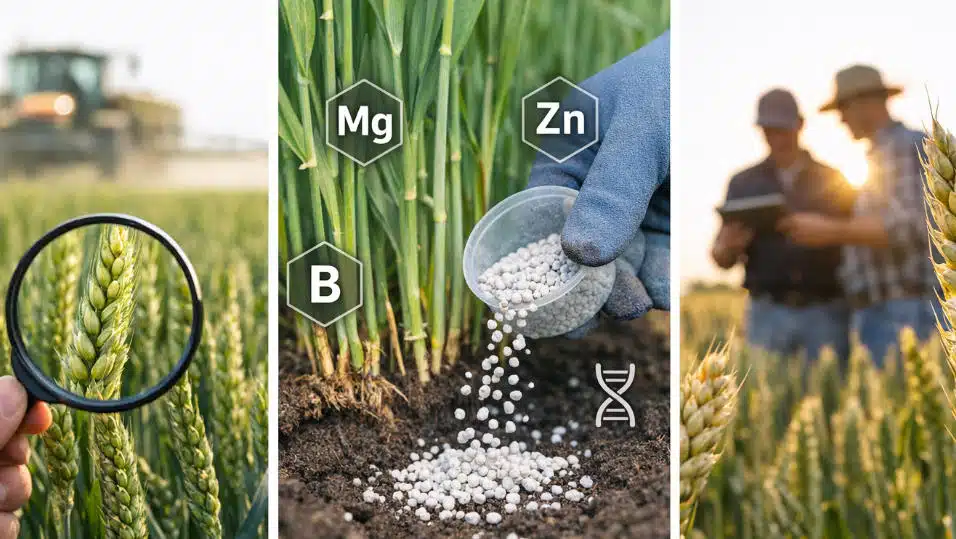
The Role of L-α Free Amino Acids in Wheat Development
L-α free amino acids are not just building blocks of proteins. In crops, they act more like metabolic accelerators.
During the mid-to-late wheat stage, highly active L-α amino acids:
- Promote ear differentiation and uniform spike emergence
- Support panicle formation and floret development
- Enhance enzymatic activity linked to nitrogen metabolism
- Help plants recover faster from environmental stress
In practical terms, this means more synchronized heading and fewer weak or undeveloped spikes.
Farmers often notice this as “more even fields”—a subtle but critical factor behind higher yield consistency.
Chelated Micronutrients: Small Elements, Big Impact
One mistake I’ve seen repeatedly is underestimating micronutrients during grain filling.
Magnesium (Mg): The Photosynthesis Stabilizer
Chelated magnesium helps maintain chlorophyll integrity. Without it, photosynthesis declines prematurely, cutting off energy supply right when grains need it most.
Zinc (Zn): The Enzyme Activator
Zinc activates starch synthase, a key enzyme responsible for converting sugars into starch inside the grain.
Boron (B): The Fertilization Guardian
Boron ensures:
- Strong pollen viability
- Successful fertilization
- Reduced floret abortion
Together, these micronutrients directly influence searches like “how to increase wheat grain weight” and “reduce empty grains in wheat naturally.”
Polyglutamic Acid: The Hidden Driver of Nutrient Efficiency
Polyglutamic acid (PGA) doesn’t act like a traditional nutrient. It works behind the scenes, improving how nutrients behave in the soil–plant system.
Its key functions include:
- Reducing nutrient leaching, especially nitrogen loss
- Enhancing nutrient retention around the root zone
- Improving soil moisture holding capacity
- Stimulating root growth and activity
More importantly, during grain filling, PGA provides continuous nutrient availability, which is critical for stable kernel development.
This aligns with growing interest in “sustainable wheat fertilization solutions” and “slow-release nutrient technologies for cereals.”
Synergy in Action: More Than the Sum of Its Parts
Individually, amino acids and PGA are effective. Together, they form a system.
- L-α amino acids → activate plant metabolism
- Chelated micronutrients → support physiological processes
- Polyglutamic acid → ensures sustained nutrient supply
This synergy results in:
- Delayed leaf senescence
- Extended photosynthetic duration
- Stronger resistance to dry hot wind and high temperature
- Improved starch and protein accumulation
Ultimately, this is what farmers see in the field:
- Fuller grains
- Higher thousand-kernel weight
- Better grain uniformity
- Increased yield and quality
What Most Growers Get Wrong — And What Actually Works
I’ve seen the same pattern across different regions.
Different soils, different climates—but the same late-stage mistakes.
Let’s put it side by side.
Wrong Approach: More Input, Less Thinking
When grain filling looks weak, the typical reaction is predictable:
- Push more nitrogen late
- Add generic foliar feeds without timing
- Ignore micronutrient balance
- Treat stress symptoms instead of the cause
On paper, it looks like action. In the field, it usually leads to:
- Excess vegetative growth instead of grain development
- Faster leaf aging after a short boost
- Poor starch accumulation
- More empty or lightweight grains
I’ve seen fields where late nitrogen made the crop look greener for a few days—
then collapse faster than untreated areas.
That’s not improvement. That’s delay.
Right Approach: Keep the System Running Longer
A better strategy is quieter. More controlled.
Instead of forcing growth, you focus on keeping the plant functional during the most critical window.
That means:
- Supporting metabolic activity with L-α amino acids
- Stabilizing photosynthesis through chelated magnesium
- Driving grain formation with zinc and boron
- Maintaining nutrient availability using polyglutamic acid (PGA)
No sudden spikes. No overcorrection.
Just a steady extension of the plant’s working life.
The Real Difference Shows Up Here
You won’t always see it immediately from the road.
But once you check closely:
| Field Condition | Wrong Program | Right Program |
|---|---|---|
| Leaf status | Burns out early | Stays active longer |
| Grain filling | Uneven, interrupted | Continuous and stable |
| Kernel weight | Light, inconsistent | Dense and uniform |
| Stress response | Sharp decline | Gradual, controlled |
| Final yield | Capped early | Fully expressed |
A More Practical Way to Look at Wheat Yield Improvement
Instead of asking “What fertilizer should I apply?”, a better question is:
“How can I keep the plant physiologically active for longer during grain filling?”
Because yield is not just about nutrient quantity—it’s about timing, efficiency, and plant response.
Specialized formulations like Wheat Yield – Wheat Late Stage Specialty Fertilizer are designed with this logic in mind:
- Activate the plant
- Protect the photosynthetic system
- Ensure nutrient continuity
- Support grain development under stress
In wheat production, the difference between an average yield and a high-performing crop often comes down to what happens in the last few weeks before harvest.
You don’t fix yield at the end—but you can absolutely enhance it if the plant still has the capacity to respond.
And that capacity depends on how well you manage biostimulation, micronutrition, and nutrient efficiency together—not separately.
