
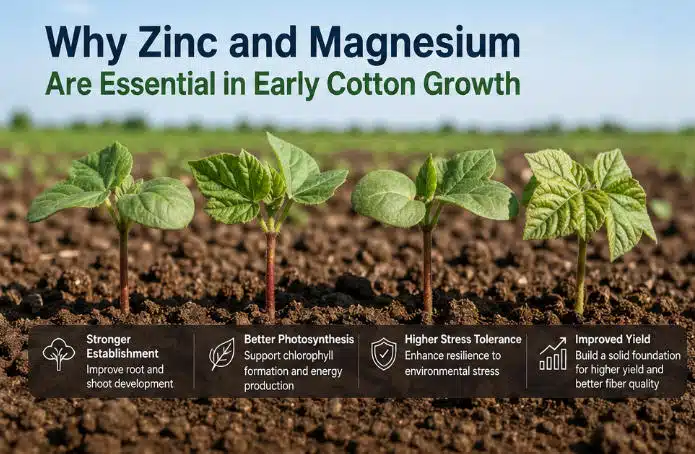
The early growth stage of cotton is often underestimated, yet it plays a decisive role in final yield and fiber quality. During this phase, cotton plants must rapidly establish roots, expand leaf area, and build metabolic capacity. Any disruption at this stage can limit the plant’s ability to recover later.
While macronutrients like nitrogen and phosphorus are widely discussed, the cotton micronutrient importance—especially zinc and magnesium—is often overlooked. In reality, deficiencies of these elements can silently reduce plant vigor before visible symptoms appear.
This article explains why zinc deficiency cotton early stage is so critical, how magnesium for cotton plants supports growth, and how both nutrients work together to ensure strong early development.
Zinc in Early Cotton Growth: Foundation for Plant Development
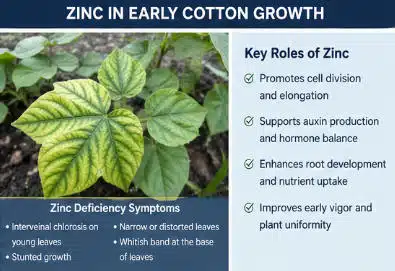
Zinc plays a fundamental role in regulating early plant growth. It is directly involved in enzyme activity, hormone balance, and cell division—all essential processes during seedling establishment.
In cotton, zinc is particularly important for:
- Root system development
- Early leaf expansion
- Growth uniformity across the field
- Transition from seedling to vegetative stage
When zinc is insufficient, cotton plants often struggle to establish properly. This is why zinc deficiency cotton early stage can have long-term consequences that extend far beyond the initial growth phase.
Common Symptoms of Zinc Deficiency
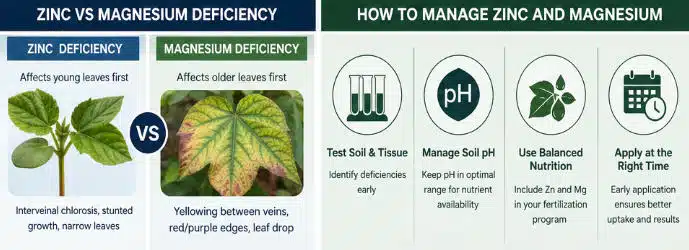
Zinc deficiency typically appears first on younger leaves due to its low mobility within the plant. Growers may observe:
- Interveinal chlorosis (yellowing between veins)
- Narrow or distorted leaves
- Shortened internodes (stunted growth)
- Pale or banded leaf tissue
In many cases, these symptoms develop unevenly, leading to poor crop uniformity—a key factor that affects later yield performance.
Why Zinc Deficiency Happens Early
Several field conditions increase the risk of early zinc deficiency:
- High soil pH (reduces zinc availability)
- Cold or wet soils (limit root uptake)
- Low organic matter
- Imbalanced fertilization programs
Because early cotton growth is already slow and sensitive, even a mild zinc shortage can significantly delay plant development.
Magnesium for Cotton Plants: Powering Photosynthesis
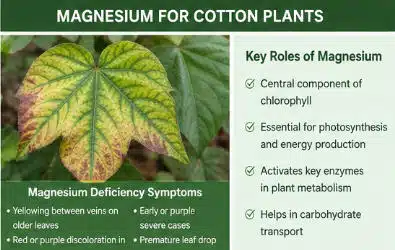
If zinc supports structure and development, magnesium supports energy production. Magnesium is a central component of chlorophyll, making it essential for photosynthesis.
For magnesium for cotton plants, its main functions include:
- Supporting chlorophyll formation
- Enhancing photosynthetic efficiency
- Activating key plant enzymes
- Assisting in carbohydrate transport
In early growth, cotton plants rely heavily on efficient photosynthesis to build biomass quickly. Without adequate magnesium, plants may appear green initially but lack the internal efficiency needed for strong growth.
Identifying Magnesium Deficiency
Unlike zinc, magnesium is mobile within the plant. As a result, deficiency symptoms appear first on older leaves:
- Yellowing between veins while veins remain green
- Red or purple discoloration in advanced stages
- Premature leaf aging or drop
These symptoms often emerge gradually, making magnesium deficiency easy to overlook until growth has already been affected.
Cotton Micronutrient Importance: Why Balance is Critical
Understanding cotton micronutrient importance means recognizing that no single nutrient works alone. Zinc and magnesium serve different but complementary roles:
- Zinc drives early growth processes and structural development
- Magnesium ensures energy production and metabolic efficiency
When both nutrients are sufficient, cotton plants can:
- Establish faster
- Develop stronger leaf area
- Improve stress tolerance
- Maintain consistent growth across the field
However, if either nutrient is limited, the plant’s overall performance declines—even if all other nutrients are adequate.
This is why modern cotton fertilization strategies increasingly emphasize balanced micronutrient management, especially during early growth stages.
Early Detection and Diagnosis
One of the biggest challenges in managing micronutrients is that deficiencies often begin before visible symptoms appear.
To identify problems early:
- Monitor young leaves for zinc-related symptoms
- Observe older leaves for magnesium-related discoloration
- Conduct soil and tissue testing during early vegetative stages
Early diagnosis is especially important for detecting zinc deficiency cotton early stage, as delayed correction can limit plant recovery and reduce yield potential.
Practical Nutrient Management Strategies
To optimize early cotton growth, growers should take a proactive approach:
1. Start with Soil and Tissue Testing
Understanding baseline nutrient levels helps prevent imbalances before planting.
2. Address High-Risk Conditions
Fields with high pH or poor soil structure may require additional zinc support.
3. Use Targeted Supplementation
Foliar or early-stage applications can help correct micronutrient deficiencies quickly.
4. Integrate with a Complete Fertilizer Program
Zinc and magnesium should be part of a broader nutrition strategy, not isolated inputs.
For a complete strategy on early-stage nutrition, refer to this guide on cotton early stage fertilizer in 2026: https://maslbiotech.com/cotton-early-stage-fertilizer-in-2026/
Zinc and magnesium are essential components of early cotton nutrition, yet they are often underapplied or overlooked. Zinc supports structural growth and early establishment, while magnesium powers photosynthesis and energy production.
By understanding the role of these nutrients and acting early, growers can avoid hidden deficiencies, improve crop uniformity, and build a stronger foundation for yield.
Ultimately, the true cotton micronutrient importance lies in timing—because in cotton production, what happens early determines everything that follows.
