
Efficient cotton production depends heavily on how well nutrients are managed throughout the season. A successful fertilization strategy is not just about how much fertilizer you apply, but when and how you apply it. Understanding cotton fertilizer timing, building a flexible cotton fertilization schedule, and using a precise cotton fertigation guide can significantly improve yield, fiber quality, and input efficiency.
This guide provides a practical, field-oriented approach to cotton fertilization, helping growers avoid costly mistakes while maximizing crop performance.
1. Understanding Cotton Nutrient Demand
Cotton plants do not require the same level of nutrients throughout their lifecycle. Nutrient demand follows a clear biological pattern:
- Early stage (emergence to squaring): Low nutrient demand, focus on root development
- Squaring to flowering: Rapid increase in nutrient uptake
- Flowering to boll development: Peak demand, especially for nitrogen and potassium
- Maturity stage: Nutrient uptake declines
This pattern explains why cotton fertilizer timing is critical. Applying nutrients too early or too late often leads to waste, excessive vegetative growth, or reduced boll retention.
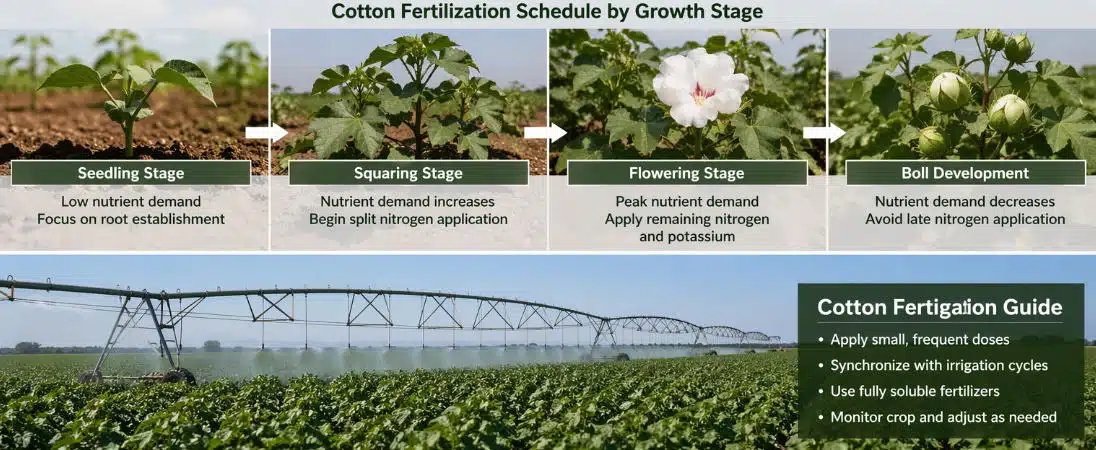
2. Cotton Fertilization Schedule (Stage-by-Stage)
A well-structured cotton fertilization schedule ensures nutrients are available exactly when the plant needs them.
Pre-Plant Stage
Before planting, soil testing should guide base fertilizer decisions.
- Apply phosphorus (P) to support early root growth
- Apply potassium (K) if soil levels are insufficient
- Incorporate fertilizers into the soil for better availability
This stage sets the foundation for uniform crop establishment.
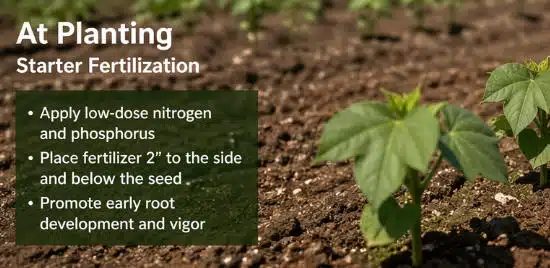
At Planting (Starter Fertilization)
Starter fertilizer helps seedlings establish quickly, especially under suboptimal soil conditions.
- Apply a low-dose nitrogen + phosphorus combination
- Avoid direct seed contact to prevent salt injury
- Focus on promoting early root vigor rather than excessive top growth
A moderate starter application improves early plant uniformity without overstimulating vegetative growth.
Early Growth (First Square Stage)
This is where your cotton fertilizer timing becomes more strategic.
- Begin split nitrogen application
- Monitor plant growth and leaf color
- Adjust based on weather and soil moisture
Nitrogen applied during this stage supports the transition from vegetative to reproductive growth.
Peak Growth (Flowering Stage)
Nutrient demand peaks during flowering and boll formation.
- Apply remaining nitrogen through side-dressing or fertigation
- Ensure adequate potassium supply for boll development
- Avoid excessive nitrogen that delays maturity
This is the most critical phase in the cotton fertilization schedule, directly influencing yield potential.
Late Season (Post-Bloom)
Late fertilization is often unnecessary and can be harmful.
- Avoid additional nitrogen applications
- Focus on crop maturity and boll opening
- Excess nutrients at this stage may reduce fiber quality
Proper cotton fertilizer timing means knowing when to stop as much as when to apply.

3. Cotton Fertigation Guide: Efficient Nutrient Delivery
For irrigated systems, a well-designed cotton fertigation guide allows growers to apply nutrients with precision.
Key Principles of Cotton Fertigation
- Apply nutrients in small, frequent doses
- Synchronize fertigation with irrigation cycles
- Use fully soluble fertilizers to prevent clogging
- Monitor plant tissue to adjust feeding rates
Fertigation is especially effective for nitrogen, allowing better control over nutrient availability during peak demand stages.
When to Use Fertigation
- Sandy soils with high nutrient leaching risk
- High-yield production systems
- Regions with controlled irrigation (drip or pivot systems)
A strong cotton fertigation guide improves nutrient efficiency and reduces fertilizer loss.
4. Fertilizer Dosage: How Much is Enough?
Fertilizer rates depend on yield goals, soil fertility, and environmental conditions. However, general guidelines can help:
Nitrogen (N)
- Typically based on yield targets
- Often applied in split applications
- Avoid over-application to prevent excessive vegetative growth
Phosphorus (P)
- Applied mainly at pre-plant or planting stage
- Critical for early root development
Potassium (K)
- Essential for boll formation and fiber quality
- Usually applied pre-plant or early season
The key is balance. A well-planned cotton fertilization schedule ensures nutrients are neither deficient nor excessive.
5. Common Cotton Fertilization Mistakes
Even experienced growers make avoidable errors. Here are the most common ones:
1. Applying Nitrogen Too Early
Excess early nitrogen leads to excessive vegetative growth and poor fruiting efficiency.
2. Ignoring Soil Testing
Without soil data, fertilizer decisions become guesswork, often leading to imbalance.
3. Poor Fertilizer Placement
Improper placement can reduce nutrient uptake or damage seedlings.
4. Over-Fertilization
More fertilizer does not equal higher yield—it often causes delayed maturity and higher costs.
5. Late-Season Nitrogen Application
Applying nitrogen too late can reduce fiber quality and delay harvest.
Avoiding these mistakes is just as important as following the right cotton fertilizer timing.
6. Best Practices for Optimizing Cotton Fertilization
To get the best results from your fertilization program:
- Always start with soil testing
- Follow a structured cotton fertilization schedule
- Use split applications for nitrogen
- Integrate a precise cotton fertigation guide when possible
- Adjust based on crop condition and environmental factors
Consistency and observation are key to long-term success.
Cotton fertilization is a dynamic process that requires careful planning and timely execution. By optimizing cotton fertilizer timing, following a stage-based cotton fertilization schedule, and implementing an efficient cotton fertigation guide, growers can significantly improve nutrient use efficiency and crop performance.
The goal is not just to feed the crop—but to feed it at the right time, in the right way, and in the right amount.
