
Selecting the best cottonearly stage fertilizer is one of the most critical decisions for growers aiming to maximize yield potential in 2026. Early nutrition doesn’t just affect seedling growth—it directly determines root strength, plant uniformity, and the crop’s ability to transition into productive reproductive stages.
Many growers still make the mistake of focusing on high nitrogen fertilizers at planting. In reality, early-stage cotton requires a more strategic approach: balanced nutrition, correct timing, and soil-specific formulation. This guide will help you identify the top cotton fertilizer solutions and choose the most effective cotton growth booster for your fields.
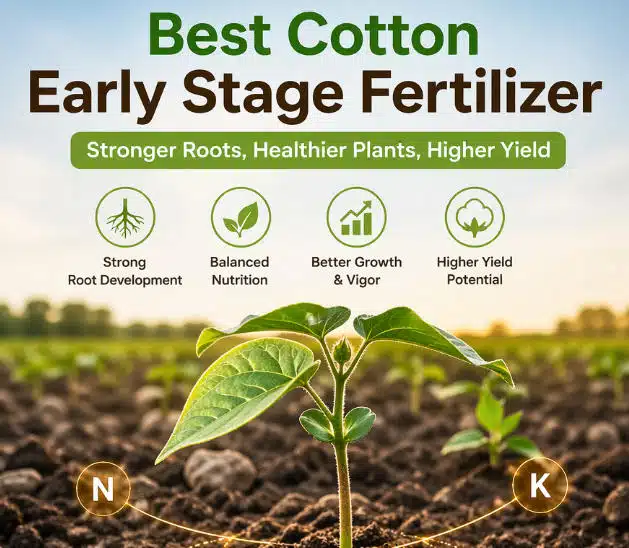
Why Early-Stage Fertilization Defines Cotton Yield
The early growth phase—from emergence to squaring—is when cotton establishes its root system and nutrient uptake capacity. If nutrition is unbalanced at this stage, the plant may never fully recover, even with later corrections.
Key impacts of early fertilization include:
- Faster root establishment
- Improved nutrient absorption efficiency
- Better tolerance to environmental stress
- More uniform plant development
- Higher yield potential later in the season
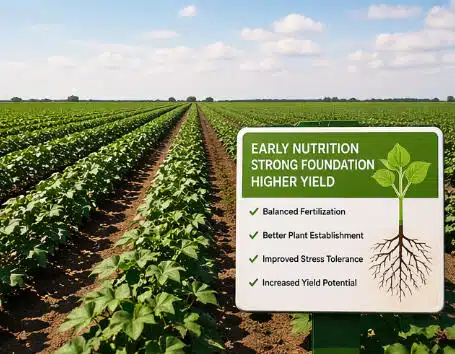
This is why choosing the best cotton fertilizer early stage is less about short-term growth and more about long-term productivity.
What Nutrients Cotton Really Needs Early On
1. Phosphorus: The Root Builder
Phosphorus is the most critical nutrient during early growth. It drives:
- Root elongation
- Energy transfer (ATP production)
- Early plant vigor
Low phosphorus availability—especially in cold soils—can significantly slow development.
2. Nitrogen: Use with Precision
Nitrogen is essential, but excessive early application can:
- Promote excessive vegetative growth
- Delay reproductive development
- Reduce nutrient efficiency
The best strategy is controlled or split application, making nitrogen part of a balanced cotton growth booster, not the dominant element.
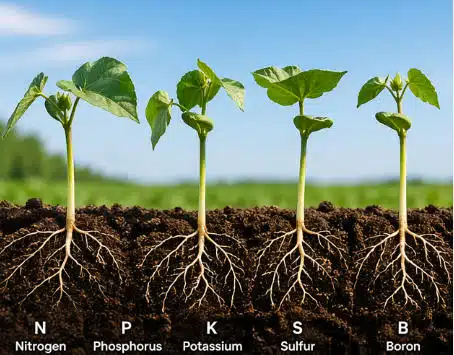
3. Potassium, Sulfur, and Boron: The Hidden Drivers
These nutrients are often overlooked but play critical roles:
- Potassium (K): Improves stress resistance and water regulation
- Sulfur (S): Supports protein synthesis and nitrogen efficiency
- Boron (B): Essential for cell development and reproductive success
A true top cotton fertilizer should consider these elements, especially in sandy or nutrient-deficient soils.
Key Features of the Best Cotton Fertilizer Early Stage
When evaluating fertilizers, focus on performance—not just NPK numbers.
A high-quality early-stage fertilizer should:
- Support strong root development
- Provide balanced, not excessive, nitrogen
- Include available phosphorus
- Match soil pH and nutrient conditions
- Offer flexibility (starter, foliar, or fertigation use)
- Improve nutrient uptake efficiency
In short, the best cotton growth booster is one that enhances plant resilience and early vigor without causing nutrient imbalance.
Types of Early-Stage Cotton Fertilizers
1. Starter Fertilizers
Starter fertilizers are designed to deliver nutrients directly near the root zone. They are particularly effective in:
- Cold soil conditions
- Low phosphorus soils
- Early planting scenarios
These are often the first choice when aiming for the best cotton fertilizer early stage performance.
2. Split Fertilization Programs
Instead of applying all nutrients at once, split programs improve efficiency:
- Small nitrogen dose at planting
- Remaining nitrogen applied later
This reduces waste and aligns with cotton’s nutrient demand curve.
3. Soil-Test-Based Custom Blends
Customized fertilizers based on soil analysis provide:
- Higher ROI
- Reduced over-fertilization
- Targeted nutrient correction
This approach is widely considered the most scientific way to choose a top cotton fertilizer.
4. Functional Growth Boosters
Modern fertilizers often include:
- Amino acids
- Humic substances
- Bio-stimulants
These improve nutrient uptake and root activity, making them effective cotton growth boosters in early stages.
Common Mistakes to Avoid
Even experienced growers can limit yield potential by making these errors:
- Applying too much nitrogen too early
- Ignoring soil pH adjustments
- Skipping phosphorus in early stages
- Using generic fertilizers without soil testing
- Delaying nutrient correction
Avoiding these mistakes is just as important as choosing the right fertilizer.
Practical Recommendation for 2026
For the 2026 season, the most effective strategy is:
- Use a balanced starter fertilizer with strong phosphorus support
- Apply controlled nitrogen levels early, then split applications
- Include sulfur and boron where needed
- Base all decisions on soil testing
This approach consistently delivers better early growth, stronger plants, and higher yield potential.
For a more detailed product-level breakdown, visit our core guide:
https://maslbiotech.com/cotton-early-stage-fertilizer-in-2026/
Conclusion
The best cotton fertilizer early stage is not defined by a single formula—it’s defined by how well it matches your soil, climate, and crop needs.
By focusing on early root development, balanced nutrition, and precise timing, growers can unlock the full genetic potential of their cotton crop. Whether you choose a starter blend, a custom formula, or a functional growth booster, the goal remains the same: build a strong foundation for yield success.
