
Modern large-scale farming is no longer just about increasing acreage — it is about optimizing productivity per hectare while maintaining soil health and operational efficiency. For commercial growers managing hundreds or thousands of acres, selecting the right Agricultural Fertilizers is a strategic decision that directly affects yield, profitability, and sustainability.
Unlike smallholder farming, large farms require structured nutrient management systems, bulk supply logistics, and precision application methods. This article explores how agricultural fertilizers support large-scale operations and what factors commercial growers should consider.
Understanding the Nutritional Demands of Large Farms
Large farms typically cultivate staple crops such as corn, wheat, soybeans, rice, or commercial vegetables. These crops remove substantial nutrients from the soil each season. Without proper replenishment, soil fertility declines, leading to reduced yields over time.
A balanced agricultural fertilizer program for large farms focuses on:
- Nitrogen (N) for vegetative growth
- Phosphorus (P) for root development and early vigor
- Potassium (K) for stress resistance and crop quality
- Secondary nutrients (Ca, Mg, S)
- Micronutrients (Zn, B, Fe, Mn, Cu)
Commercial growers often search for terms like bulk agricultural fertilizers for large farms, fertilizer application rates per acre, and cost-effective crop nutrition solutions, highlighting the need for both efficiency and economic viability.
Types of Agricultural Fertilizers Suitable for Large-Scale Operations
1. Granular Fertilizers for Broad Acreage Application
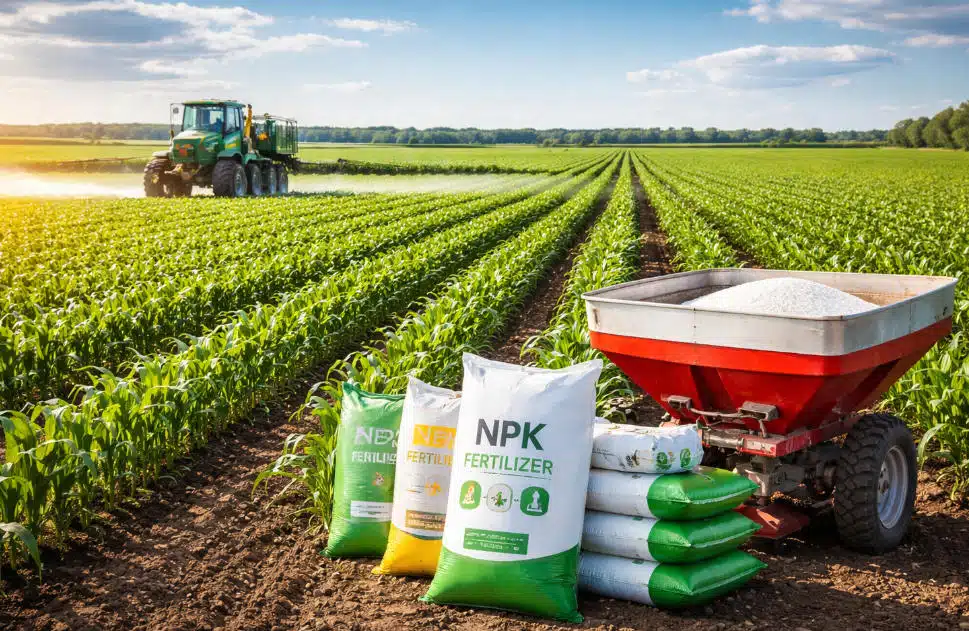
Granular NPK fertilizers remain the most common choice for large farms. They are easy to store, transport, and apply using spreaders across wide fields.
Advantages include:
- Uniform nutrient distribution
- Compatibility with mechanical spreaders
- Long shelf life
- Suitable for pre-plant and base fertilization
For farms practicing conventional row cropping, bulk granular agricultural fertilizers offer operational convenience and predictable performance.
2. Liquid Fertilizers for Precision Agriculture
As precision farming technologies expand, many large-scale growers are shifting toward liquid fertilizer systems.
Liquid agricultural fertilizers are often used in:
- Fertigation systems
- Variable rate application (VRA)
- Starter fertilizers during planting
When integrated with GPS-guided equipment, liquid fertilizers improve nutrient-use efficiency and reduce over-application. Searches such as precision agriculture fertilizers for commercial farms reflect this growing trend.
3. Controlled-Release and Enhanced Efficiency Fertilizers
For large farms concerned with nutrient loss and environmental compliance, enhanced efficiency fertilizers are gaining popularity.
These products:
- Reduce nitrogen leaching
- Minimize volatilization losses
- Provide extended nutrient release
Although the initial cost may be higher, they often improve return on investment through improved yield stability and reduced environmental risk.
Developing a Fertilizer Program for Large Farms
A successful agricultural fertilizer strategy begins with data. Soil testing is essential to determine baseline fertility levels and nutrient deficiencies.
Key steps include:
- Comprehensive Soil Analysis
Large farms should conduct grid or zone sampling to support variable rate fertilization. - Yield Goal-Based Planning
Fertilizer rates should align with realistic yield targets rather than generalized recommendations. - Nutrient Budget Calculation
Account for nutrients removed by harvested crops and adjust application accordingly. - Application Timing Optimization
Split nitrogen applications can improve uptake efficiency and reduce losses.
Growers often look for fertilizer recommendations for high-yield commercial crops or best agricultural fertilizers for large acreage farming, emphasizing the importance of practical, field-based strategies.
Cost Management and Bulk Fertilizer Procurement
For large farms, fertilizer represents a significant portion of production costs. Efficient procurement strategies are critical.
Best practices include:
- Contract purchasing during off-season
- Working directly with fertilizer manufacturers or bulk suppliers
- Evaluating price per nutrient unit rather than price per ton
- Considering logistics and storage capacity
Bulk agricultural fertilizer supply agreements can help stabilize input costs and ensure consistent quality across growing seasons.
Sustainability Considerations in Large-Scale Farming
Environmental regulations and consumer expectations are increasingly influencing fertilizer management.
Large farms are adopting:
- Precision nutrient management
- Soil organic matter improvement programs
- Integrated crop nutrition strategies
- Reduced nutrient runoff practices
Sustainable agricultural fertilizers not only protect soil resources but also support long-term farm profitability.
Technology Integration in Fertilizer Application
Modern large farms rely heavily on agricultural technology, including:
- GPS-guided spreaders
- Variable rate technology (VRT)
- Yield mapping systems
- Remote sensing for nutrient deficiency detection
Combining advanced equipment with appropriate agricultural fertilizers improves input efficiency and reduces waste.
For large-scale operations, agricultural fertilizers are not just inputs — they are strategic tools for maximizing productivity and protecting soil health. The right fertilizer program balances nutrient efficiency, cost control, environmental responsibility, and yield optimization.
By integrating soil testing, precision technology, and reliable bulk fertilizer supply, large farms can build resilient nutrient management systems that support both short-term productivity and long-term sustainability.
