
Early corn growth determines the crop’s capacity to capture nutrients, water, and sunlight throughout the season. From emergence through the V6 stage, corn plants establish nodal roots, define leaf number, and build the foundation for yield. During this period, nutrient efficiency matters as much as nutrient availability.
Field Crops Early Stage Specialty Fertilizer, formulated with L-α free amino acids, supports early corn growth by working directly with plant metabolic processes rather than forcing growth through high nutrient rates.
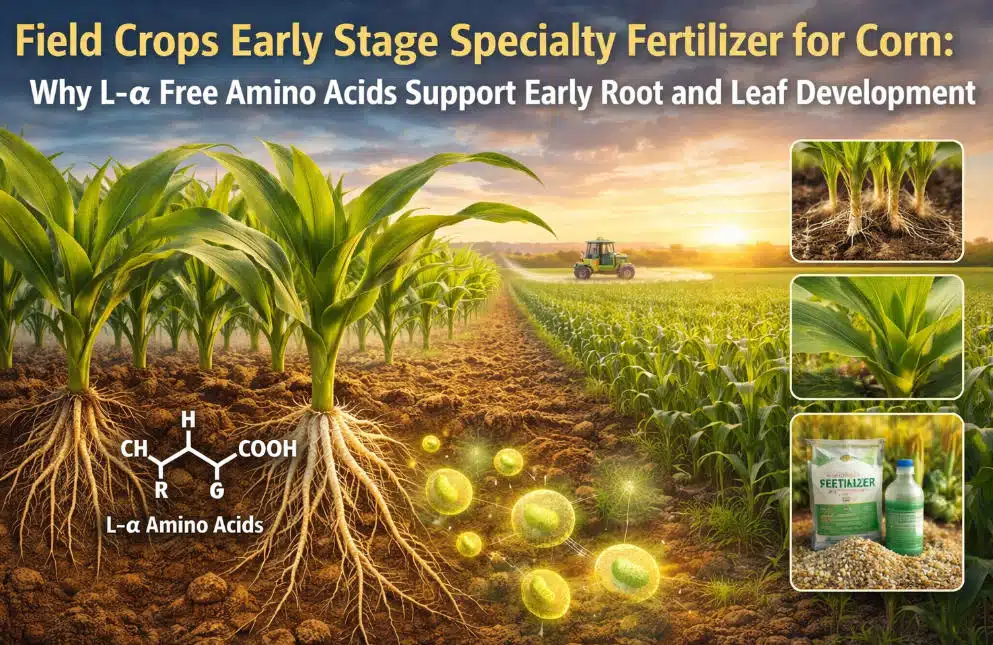
Why L-α Free Amino Acids Matter in Corn Nutrition
Corn plants naturally synthesize and utilize amino acids in the L-α configuration. These are the biologically active forms recognized by plant enzymes involved in protein synthesis and metabolism. When supplied externally in free L-α form, amino acids can be directly absorbed and used without conversion.
For young corn plants with limited photosynthetic capacity, this reduces the energy required for nitrogen assimilation and supports more efficient early growth.
Supporting Nodal Root Development
The transition from seminal roots to nodal roots is a critical phase in corn development. L-α free amino acids provide readily available substrates for cell division in root meristems, supporting:
- Faster nodal root initiation
- Increased root branching
- Improved uptake of phosphorus and zinc
Stronger early root systems improve stand uniformity and help corn tolerate cool or compacted soils.
Improving Early Leaf Growth and Nitrogen Efficiency
Early leaves determine how quickly corn plants reach full photosynthetic activity. By supplying amino acids directly, early-stage specialty fertilizer supports protein synthesis and chlorophyll formation while reducing metabolic stress.
From an agronomic standpoint, this leads to steady early growth rather than excessive vegetative response.


