
In field crop production, early growth stages are often underestimated. Yet from an agronomic perspective, this period determines root architecture, nutrient uptake capacity, and the crop’s ability to handle stress later in the season. At this stage, the form in which nutrients are supplied can be just as important as the nutrient rate itself.
This is why Field Crops Early Stage Specialty Fertilizer formulated with L-α free amino acids has gained attention. The effectiveness of this type of fertilizer is not based on higher nutrient concentration, but on how closely it aligns with plant metabolic processes at the cellular level.
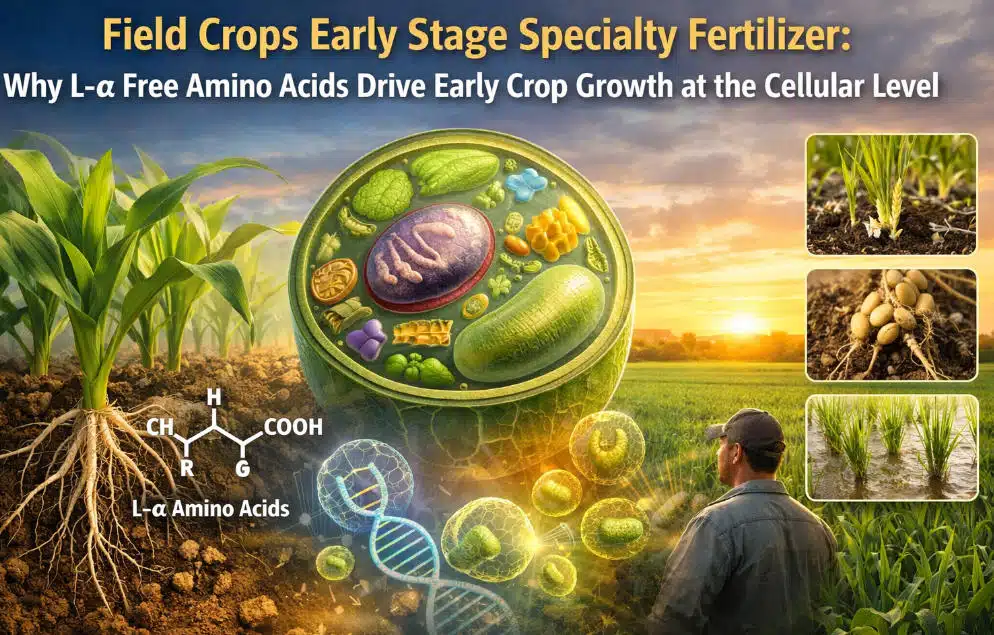
L-α Free Amino Acids: The Biologically Active Form Plants Actually Use
Amino acids are central to plant growth. They are the basic components of proteins and enzymes, and they participate directly in metabolic regulation. However, plants do not use all amino acid forms equally.
In nature, plant metabolic systems are designed to recognize and utilize L-α amino acids. These are the same amino acids synthesized within plant cells during normal nitrogen metabolism. Enzymes involved in protein synthesis, respiration, and photosynthesis are structurally compatible with the L-α configuration.
When amino acids are supplied in this free L-α form, they can be directly incorporated into plant metabolism without conversion. Other forms—such as D-type amino acids or complex protein hydrolysates—require additional transformation or may be only partially utilized.
From an agronomic standpoint, this compatibility is what gives L-α free amino acids their practical value during early crop development.
Energy Efficiency Matters in Early Crop Stages
Young field crops operate under tight energy budgets. Root systems are limited, leaf area is small, and photosynthetic capacity is still developing. Under these conditions, plants prioritize survival and establishment.
Traditional nitrogen fertilizers supply nitrogen in inorganic forms that must be converted into amino acids inside the plant. This conversion process consumes energy and depends on enzyme activity that may be restricted under cool soils, moisture stress, or low root activity.
L-α free amino acid fertilizers reduce this metabolic cost.
By supplying amino acids directly, plants bypass part of the nitrogen assimilation pathway. This allows crops to:
- Maintain growth under early stress conditions
- Allocate more energy to root and shoot development
- Improve nitrogen use efficiency during establishment
This effect is particularly relevant in early-season applications when soil and environmental conditions are less than optimal.
Root Development: The First Agronomic Response
One of the earliest observable responses to L-α free amino acids is improved root growth. From a physiological perspective, root meristem cells divide rapidly during early stages and require a steady supply of amino acids for protein synthesis.
Free L-α amino acids support this process by providing:
- Readily available substrates for new cell formation
- Faster initiation of lateral roots
- Improved root surface area for nutrient and water uptake
In field conditions, this often translates into more uniform emergence, better early vigor, and improved access to soil nutrients such as phosphorus and micronutrients.
Supporting Cell Division and Leaf Development
Above ground, early vegetative growth depends on continuous cell division and expansion. Amino acids are directly involved in the synthesis of structural proteins, enzymes, and chlorophyll-related compounds.
When L-α free amino acids are available:
- Protein synthesis proceeds more efficiently
- Enzyme systems regulating metabolism remain active
- Leaf expansion and early photosynthetic capacity improve
This does not result in excessive vegetative growth, but rather in balanced, steady development, which is generally preferred in field crops for long-term yield stability.
Amino Acids as Functional Metabolic Regulators
Beyond their role as nutrients, amino acids also function as metabolic regulators. Certain amino acids influence osmotic balance, antioxidant activity, and stress-related metabolic pathways.
In practical terms, this means crops receiving L-α free amino acids during early growth may show:
- Better tolerance to temperature fluctuations
- Faster recovery from early nutrient or moisture stress
- More stable growth patterns under variable field conditions
This is why amino acid-based products are often classified not only as fertilizers, but also as biostimulants.
Why L-α Type Matters in Field Crops Early Stage Specialty Fertilizer
The formulation of Field Crops Early Stage Specialty Fertilizer reflects these agronomic principles. The focus is not on forcing growth, but on supporting natural physiological processes when crops are most sensitive.
By combining L-α free amino acids with essential micronutrients such as magnesium, manganese, zinc, and Vitamin B1, the fertilizer supports:
- Early metabolic activation
- Efficient nutrient utilization
- Stable cell-level growth during establishment
This approach aligns well with practical field management strategies aimed at building yield potential from the start.
Final Agronomic Perspective
Early-stage crop nutrition is most effective when it works with plant biology, not against it. L-α free amino acids represent the form that plants naturally recognize and use, making them especially suitable for early applications in field crops.
By addressing growth at the cellular and metabolic level, Field Crops Early Stage Specialty Fertilizer supports stronger roots, efficient nitrogen use, and consistent early development—key foundations for stable yields later in the season.


