
If you’ve ever wondered why some vegetable crops thrive while others struggle—despite similar weather and care—the answer often comes down to one thing: fertilizer choice.
Selecting the right Fertilizer for Vegetable crops isn’t just about picking a product with a high NPK number. It’s about understanding what your plants actually need, when they need it, and how those nutrients are delivered. Whether you’re growing leafy greens in a greenhouse or managing open-field production, making the right decision here can dramatically improve both yield and quality.
In this guide, we’ll walk through how to choose vegetable fertilizer in a way that’s practical, realistic, and rooted in how growers actually work. We’ll also take a closer look at what makes the best vegetable fertilizer, especially for high-demand crops like spinach and lettuce.
Why Fertilizer Choice Matters More Than You Think
It’s easy to underestimate fertilizer. After all, plants grow in soil—shouldn’t that be enough?
In reality, modern agriculture places significant demands on soil nutrients. Intensive planting cycles, irrigation, and high-yield varieties quickly deplete available nutrients. Without proper supplementation, even healthy-looking soil can fall short.
The right fertilizer does more than just “feed” plants. It influences:
- Leaf size and color
- Growth speed
- Resistance to stress
- Market quality and shelf life
For leafy crops, in particular, the difference is visible within days. A well-fed lettuce crop looks vibrant and uniform, while a poorly nourished one appears pale and uneven.
That’s why choosing the right fertilizer for spinach and lettuce is not optional—it’s foundational.
Understanding What Vegetables Actually Need
Before comparing products, it helps to step back and think about plant biology. Vegetables don’t need “fertilizer” in a general sense—they need specific nutrients in the right balance.
The Core Nutrients
Most fertilizers revolve around three primary elements:
- Nitrogen (N): Drives leaf growth and chlorophyll production
- Phosphorus (P): Supports root development and early plant establishment
- Potassium (K): Improves plant strength, water regulation, and disease resistance
For leafy greens like spinach and lettuce, nitrogen is especially important. This is why many growers prioritize liquid fertilizer for leafy greens with higher nitrogen content during the vegetative stage.
Secondary Nutrients and Micronutrients
Beyond NPK, crops also depend on:
- Calcium (for cell structure)
- Magnesium (for photosynthesis)
- Iron and zinc (for enzyme function)
Ignoring these can lead to subtle deficiencies that reduce overall crop quality—even if growth appears normal at first.
Different Types of Vegetable Fertilizers (And When to Use Them)
There’s no single “best” fertilizer for all situations. The right choice depends on your crop, environment, and management style.
1. Granular Fertilizers: Reliable and Long-Lasting
Granular fertilizers are widely used in field agriculture because they release nutrients gradually.
They’re a good fit if you:
- Grow vegetables in open fields
- Want fewer applications
- Prefer a steady nutrient supply
However, they don’t act quickly. If your crop shows signs of deficiency, you may need a faster solution.
2. Liquid Fertilizer for Leafy Greens: Fast and Efficient
Liquid fertilizers are becoming increasingly popular, especially in greenhouse and controlled environments.
A well-formulated liquid fertilizer for leafy greens offers:
- Rapid absorption through leaves and roots
- Immediate correction of nutrient deficiencies
- Better control over nutrient delivery
This is particularly useful for crops like lettuce, where growth cycles are short and timing matters.
3. Organic vs. Conventional Fertilizers
Both approaches have their place.
- Organic fertilizers improve soil health over time and are often used in sustainable farming systems
- Conventional fertilizers provide precise nutrient ratios and faster, more predictable results
Many modern growers use a combination of both—balancing soil health with performance.
How to Choose Vegetable Fertilizer (Step-by-Step)
Let’s break this down into a practical process you can actually follow.
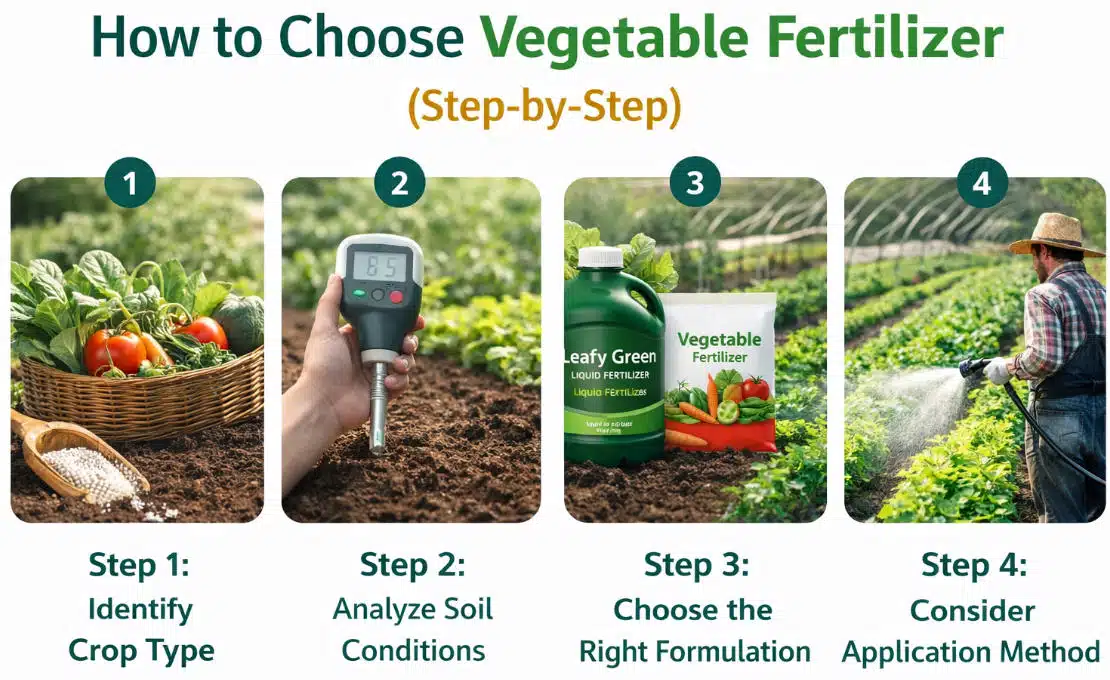
Step 1: Start With the Crop, Not the Product
Different vegetables have very different nutrient demands.
For example:
- Leafy greens → high nitrogen
- Root vegetables → balanced nutrients
- Fruiting crops → higher potassium later in the cycle
If your focus is leafy crops, look specifically for fertilizer for spinach and lettuce rather than a general-purpose blend.
Step 2: Check Your Soil (Even If It Looks Fine)
A soil test might seem like an extra step, but it often saves money and prevents mistakes.
It tells you:
- What nutrients are already available
- What’s missing
- Whether your pH is suitable for nutrient uptake
Without this information, it’s easy to overapply fertilizer—which can harm plants and reduce efficiency.
Step 3: Match the Fertilizer to Your Growing System
Your production method matters more than many people realize.
- Open field → slow-release or granular fertilizers
- Greenhouse → controlled liquid feeding
- Hydroponics → 100% water-soluble nutrient solutions
For example, growers using hydroponics often search for fertilizer for hydroponic lettuce, which requires precise, water-soluble formulations.
Step 4: Consider Growth Stage Timing
Plants don’t need the same nutrients all the time.
- Early stage → balanced nutrients for root development
- Vegetative stage → nitrogen-heavy feeding
- Late stage → stable nutrition for quality maintenance
Using the same fertilizer throughout the entire cycle is a common mistake.
Step 5: Evaluate Product Quality Carefully
Not all fertilizers are created equal. Two products with similar labels can perform very differently.
Look for:
- Consistent formulation
- High solubility (especially for liquid products)
- Low impurity levels
- Reliable manufacturer reputation
This is where working with a trusted supplier like MASL becomes important. Consistency and quality control can make a measurable difference in crop outcomes.
What Makes the Best Vegetable Fertilizer?
The term “best vegetable fertilizer” gets used a lot, but it really depends on context.
That said, high-performing fertilizers usually share a few characteristics:
1. Balanced and Targeted Nutrition
They’re designed for specific crop types, not just general use.
2. Efficient Absorption
Plants can actually take up the nutrients quickly and effectively.
3. Compatibility With Modern Farming
They work well with irrigation systems, foliar application, or hydroponics.
4. Stability and Safety
They don’t cause leaf burn or soil imbalance when used correctly.
Choosing Fertilizer for Spinach and Lettuce
Spinach and lettuce are among the most sensitive and fast-growing crops. Small mistakes can show up quickly.
When selecting a fertilizer for spinach and lettuce, focus on:
- High nitrogen content for leaf growth
- Quick absorption to support rapid cycles
- Low salt index to prevent leaf burn on delicate foliage
Many growers find that a liquid fertilizer for leafy greens works best, especially in greenhouse environments where precision matters.
Common Mistakes Growers Still Make
Even experienced growers sometimes run into avoidable issues.
Here are a few to watch for:
Over-Fertilization
More is not always better. Excess nutrients can damage roots and reduce yield.
Using One Formula for Everything
Different crops—and even different growth stages—require different nutrient profiles.
Ignoring Micronutrients
Deficiencies in iron or magnesium may not be obvious at first but can affect long-term quality.
Poor Timing
Applying fertilizer too late (or too early) reduces its effectiveness.
Why More Growers Are Turning to MASL
In a market full of options, reliability matters.
MASL focuses on developing fertilizer solutions that align with how modern growers actually operate. That includes:
- Advanced formulations for leafy vegetables
- High-efficiency liquid fertilizer for leafy greens
- Custom OEM/ODM solutions for distributors and agricultural brands
- Consistent production standards
Instead of one-size-fits-all products, MASL emphasizes targeted solutions—helping growers match fertilizers to specific crops and systems.
You can explore more at: https://maslbiotech.com/product-category/vegetable-fruit-crop/
A Smarter Approach to Fertilization
Choosing the right fertilizer for vegetable production isn’t about following a fixed formula. It’s about observation, adjustment, and understanding your crops.
Start with your plants. Pay attention to how they respond. Adjust your approach as needed.
Over time, you’ll develop a system that works—not just in theory, but in your specific growing conditions.
If there’s one takeaway from this guide, it’s this: fertilizer choice is not a small detail—it’s a major driver of success.
By learning how to choose vegetable fertilizer based on crop type, soil condition, and growth stage, you can significantly improve both yield and quality.
And when it comes to fast-growing crops like lettuce and spinach, selecting the right fertilizer for spinach and lettuce—especially a well-formulated liquid fertilizer for leafy greens—can make all the difference.
For growers looking for consistency, performance, and modern solutions, MASL continues to be a reliable partner in achieving better agricultural results.
