
A Targeted Nutrition Strategy for Yield and Fiber Quality Improvement
The late growth stage of cotton—from peak flowering through boll development and fiber maturation—is a decisive period for determining final yield, fiber strength, and uniformity. During this phase, cotton plants face increasing physiological pressure, including nutrient redistribution, declining leaf function, boll shedding risk, and environmental stress. Conventional fertilization programs often fail to address these complex physiological demands, leading to premature leaf senescence, poor boll retention, and suboptimal fiber development.
To address these challenges, Cotton Late Stage Specialty Fertilizer developed by MASLBIOTECH is specifically formulated for mid-to-late cotton growth stages. It integrates highly active L-α free amino acids, chelated micronutrients, and functional biopolymers to support boll setting, fiber cell development, and sustained photosynthetic efficiency.
Nutritional Challenges in Late-Stage Cotton
As cotton transitions into reproductive dominance, nutrient demand shifts from vegetative expansion to:
- Continuous carbohydrate supply for developing bolls
- Stable hormone balance to reduce physiological boll shedding
- Sustained leaf photosynthetic activity
- Proper cellulose synthesis for fiber thickening
- Improved stress tolerance under heat, drought, or nutrient imbalance
Late-stage nutrient deficiencies—especially Magnesium, Zinc, and Boron—can directly compromise boll filling and fiber quality, even when early fertilization appears adequate.
L-α Free Amino Acids: The Core Physiological Driver
Highly active L-α free amino acids serve as the functional core of the formulation. Unlike protein hydrolysates, these amino acids are directly absorbed and metabolized by cotton plants.
Key functions include:
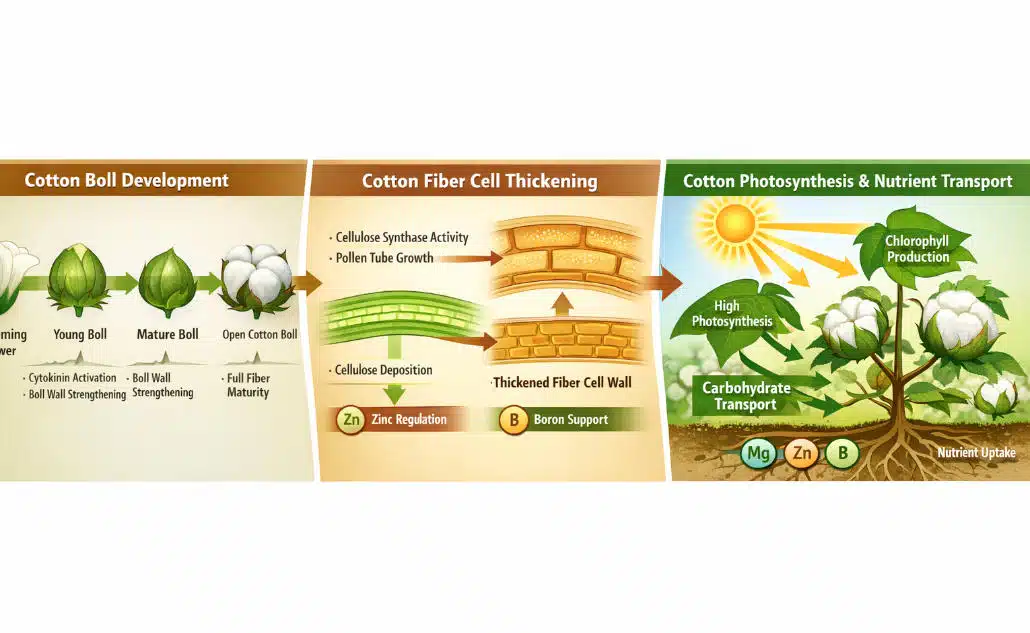
- Activation of cytokinin synthesis within bolls, enhancing cell division and reducing physiological boll shedding
- Promotion of fiber cell elongation and differentiation, improving fiber length potential
- Strengthening of boll walls, increasing resistance to environmental stress and improving boll retention
By acting as both metabolic substrates and signaling molecules, L-α free amino acids enhance internal nutrient efficiency during the most critical reproductive stage.
Synergistic Magnesium: Sustaining Functional Leaves
Chelated Magnesium (Mg) plays a central role in maintaining chlorophyll integrity and photosynthetic capacity. During late growth stages, Magnesium deficiency often accelerates leaf aging and carbohydrate shortage.
In synergy with amino acids, chelated Magnesium:
- Maintains leaves in a highly photosynthetically active state
- Ensures continuous production and transport of carbohydrates to developing bolls
- Delays premature senescence of functional leaves
This sustained source–sink balance is essential for stable boll filling and uniform fiber development.
Zinc and Boron: Precision Regulation of Fiber Formation
Fiber quality formation is closely linked to micronutrient-regulated enzymatic processes.
- Chelated Zinc (Zn) precisely regulates key cellulose synthase enzymes, directly influencing fiber cell wall synthesis and thickness
- Water-soluble Boron (B) supports pollen tube elongation and fertilization quality, ensuring effective boll set
Together, Zinc and Boron promote:
- Uniform boll expansion
- Enhanced fiber cell wall thickening
- Improved fiber strength and consistency
This micronutrient synergy establishes a solid foundation for both yield stability and premium fiber quality.
Polyglutamic Acid: Enhancing Stress Resistance and Nutrient Utilization
The formulation is further enhanced with highly active Polyglutamic Acid (γ-PGA), a bio-functional polymer with proven agronomic benefits.
Polyglutamic Acid:
- Improves nutrient chelation and root absorption efficiency
- Enhances internal nutrient transport and utilization
- Reduces crop stress caused by heat, drought, or nutrient imbalance
By improving nutrient efficiency under stress conditions, γ-PGA supports consistent boll development and contributes to overall yield improvement.
Practical Value in Late-Stage Cotton Management
Cotton Late Stage Specialty Fertilizer is designed to integrate seamlessly into modern cotton nutrition programs, particularly during flowering, boll setting, and boll filling stages. Its balanced physiological approach supports:
- Reduced boll shedding
- Sustained photosynthesis
- Improved boll uniformity
- Enhanced fiber thickness and strength
- Higher yield stability under variable field conditions
Effective fertilization during the later stages of cotton growth requires more than nutrient supplementation—it demands precise physiological regulation. By combining L-α free amino acids, chelated Magnesium, Zinc, Boron, and Polyglutamic Acid, MASLBIOTECH’s Cotton Late Stage Specialty Fertilizer provides a scientifically balanced solution for maximizing cotton yield and fiber quality during the most critical growth period.


