
Introduction: Why Early-Stage Fertilization Determines Cotton Performance
The early-to-mid growth stages of cotton represent a critical physiological window that determines root architecture, vegetative vigor, stress tolerance, and the plant’s capacity to support future flower bud differentiation and boll development. During this period, cotton plants transition rapidly from seedling establishment to structural formation, making precise and efficient nutrition management essential.
Traditional fertilization practices often emphasize macronutrients while overlooking the biochemical activation of roots, enzyme systems, and stress-defense mechanisms. To address these limitations, Cotton Early Stage Specialty Fertilizer is specifically developed to align with cotton’s early physiological demands, delivering targeted nutrition that supports both structural growth and metabolic efficiency.
Nutritional Challenges During Early-to-Mid Cotton Growth
In the early stages, cotton plants commonly face several constraints:
- Slow root expansion and limited nutrient absorption
- Weak stem structure, increasing lodging risk
- Micronutrient deficiencies causing chlorosis and growth stagnation
- Environmental stress from temperature fluctuations and early-season drought
An effective early-stage fertilization strategy must therefore focus not only on nutrient supply, but also on root activation, photosynthetic efficiency, and stress resistance.
Cotton Early Stage Specialty Fertilizer: Precision Nutrition by Design
L-α Free Amino Acids: Activating Roots and Structural Development
At the core of this formulation are highly active L-α free amino acids, which serve as both nutrient carriers and metabolic activators.
Their physiological functions include:
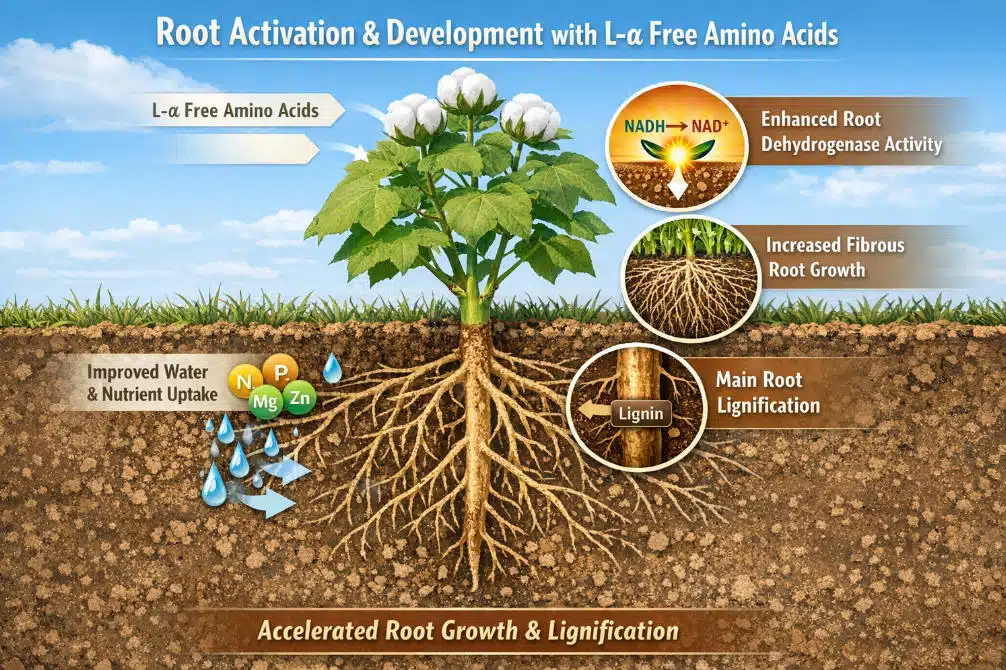
- Activation of root dehydrogenase enzymes, accelerating root respiration and energy metabolism
- Rapid proliferation of fibrous roots and enhanced main root lignification, forming a deep, resilient root system
- Significantly improved water and mineral nutrient uptake efficiency, especially under fluctuating soil conditions
Beyond roots, L-α free amino acids also promote stem collenchyma differentiation, strengthening cell walls and creating a lodging-resistant framework. This structural reinforcement provides essential mechanical support for subsequent flower bud initiation and retention.
Chelated Magnesium, Manganese, and Zinc: Driving Photosynthesis and Growth Continuity
To complement amino acid activation, the fertilizer integrates a chelated Mg–Mn–Zn triple synergy system, ensuring high bioavailability and rapid plant absorption.
- Magnesium (Mg) serves as the central atom of chlorophyll molecules, directly supporting chlorophyll synthesis and energy capture
- Manganese (Mn) activates key photosynthetic and respiratory enzymes, enhancing electron transport efficiency
- Zinc (Zn) regulates auxin synthesis and enzyme activity, promoting balanced internode elongation and leaf expansion
This micronutrient synergy effectively prevents deficiency-induced yellowing, dwarfing, and early photosynthetic decline, ensuring that photosynthates are efficiently produced and transported to new growth points and developing tissues.
Glutathione: Early Stress Defense and Physiological Stability
Early cotton growth is frequently challenged by cold stress, drought stress, and oxidative damage. The inclusion of Glutathione, a powerful endogenous antioxidant, provides advanced physiological protection.
Key benefits include:
- Scavenging free radicals generated by environmental stress, protecting cell membranes and chloroplast integrity
- Maintaining photosynthetic system stability, even under suboptimal conditions
- Enhancing plant tolerance to early-season drought and low-temperature stress
Through this mechanism, Glutathione works synergistically with amino acids and micronutrients to shape a stress-resistant cotton plant type, characterized by tough stems, thick leaves, and stable metabolic activity.
Building a Foundation for Boll Stage Energy Conversion
By optimizing root absorption, strengthening stem structure, enhancing photosynthesis, and stabilizing stress responses, Cotton Early Stage Specialty Fertilizer establishes a high-efficiency physiological foundation. This foundation ensures:
- Strong nutrient reserves for reproductive growth
- Efficient conversion of photosynthetic products during the boll-setting and boll-filling stages
- Improved yield stability and fiber quality potential
Rather than short-term vegetative stimulation, this early-stage nutrition strategy focuses on long-term productivity and resilience.
Effective early-stage cotton fertilization requires more than basic nutrient supply—it demands precision nutrition aligned with plant physiology. Cotton Early Stage Specialty Fertilizer delivers a scientifically balanced system combining L-α free amino acids, chelated micronutrients, and Glutathione to support root vigor, structural strength, photosynthetic efficiency, and stress resistance. By investing in early-stage physiological optimization, growers can unlock stronger crop performance and higher yield potential throughout the season.


