
Cotton early growth is one of the most important windows in the entire season. What happens in the first weeks after emergence affects root development, leaf expansion, plant uniformity, square retention, and ultimately yield potential. That is why growers often ask a practical question: should they rely more on foliar fertilizer cotton programs, or should they focus on soil-applied fertilizer?
The answer is not always “one or the other.” In most early-stage cotton systems, soil nutrition and foliar feeding play different roles. Soil fertilizer supports the plant’s long-term nutritional foundation, while foliar fertilizer can act as a fast correction tool when the crop needs a quick boost. Understanding the difference between foliar vs soil fertilizer for cotton helps growers make better decisions during the critical early stage.
Why early-stage cotton nutrition matters
Cotton seedlings are small, but their nutritional needs are already active. During early establishment, the plant is building:
- a stronger root system
- a healthy canopy
- efficient nutrient uptake capacity
- stress tolerance against cold, drought, or transplant shock
- a strong base for later flowering and boll formation
If nutrition is weak at this stage, cotton may struggle to catch up later. Poor early growth can lead to uneven stands, delayed maturity, and lower yield potential. That is why early fertilizer strategy should be planned carefully rather than applied randomly.
What is soil fertilizer for cotton?
Soil fertilizer is applied directly to the root zone or incorporated into the soil before or during planting. It supplies nutrients through the root system as the plant grows.
Typical soil fertilizer programs may include:
- base fertilizer before planting
- starter fertilizer near the seed row
- side-dressing during early vegetative growth
- balanced macro and micronutrient management
Advantages of soil fertilizer
Soil fertilizer is usually the foundation of crop nutrition because it provides nutrients in a more stable and continuous way. Its main strengths are:
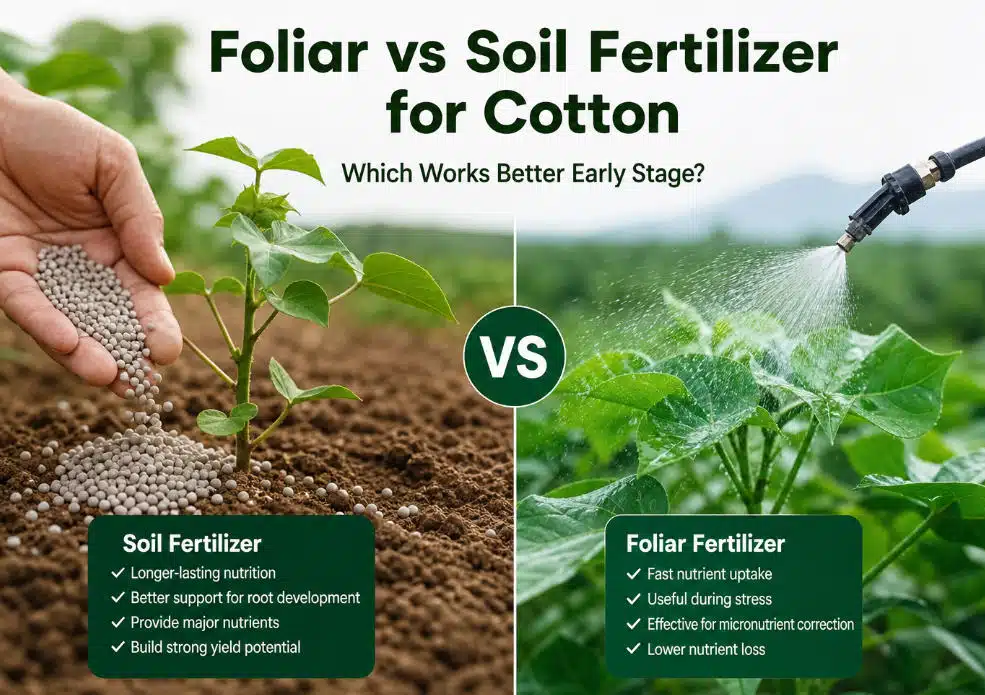
- Longer-lasting nutrition
Nutrients in the soil can feed the crop over time, especially when applied correctly with good soil conditions. - Better support for root development
Early root growth depends heavily on nutrient availability in the root zone. - More suitable for major nutrient supply
Nitrogen, phosphorus, and potassium are typically best handled through soil programs. - Better for building yield potential
A strong soil fertility base supports the crop through later growth stages.
Limitations of soil fertilizer
Soil fertilizer is not perfect. Its performance can be affected by:
- dry or cold soil conditions
- nutrient fixation or leaching
- poor root activity
- alkaline or acidic soil problems
- slow nutrient movement in the soil
When these issues occur, even a well-planned soil program may not fully meet the plant’s immediate needs.
What is foliar fertilizer for cotton?
Foliar fertilizer is sprayed onto the leaves, where nutrients are absorbed directly through the plant tissue. It is usually used to correct deficiencies or support the crop during stress.
Foliar sprays may contain:
- nitrogen in low doses
- phosphorus or potassium in quickly available forms
- micronutrients such as zinc, boron, magnesium, or manganese
- amino acids or biostimulants in some formulations
Foliar feeding benefits
The main foliar feeding benefits are speed and precision. Foliar nutrition can help when the crop needs a quick response.
- Fast nutrient uptake
Leaves can absorb nutrients much faster than roots in some situations. - Useful during stress
When roots are weak, cold, or stressed, foliar sprays can provide temporary support. - Good for micronutrient correction
Foliar feeding is often effective for fixing visible or hidden micronutrient shortages. - Lower nutrient loss
Because the nutrients are sprayed directly onto the plant, there may be less loss compared with some soil-applied nutrients.
Limitations of foliar fertilizer
Foliar fertilizer is helpful, but it should not replace the full soil nutrition plan.
- it usually provides only a small amount of total nutrients
- it works best as a supplement, not the main source
- overuse can risk leaf burn or wasted product
- it may need repeated applications for lasting effect
Foliar vs soil fertilizer for cotton: the key difference
When comparing foliar vs soil fertilizer for cotton, the most important point is that they do not compete in the same way. They solve different problems.
Soil fertilizer is best for:
- establishing the main nutrient base
- supporting root-zone feeding
- delivering large nutrient amounts
- building long-term crop performance
Foliar fertilizer is best for:
- quick correction of nutrient shortages
- helping the plant during stress
- supplying micronutrients efficiently
- supporting early growth when root uptake is limited
In simple terms, soil fertilizer builds the foundation, while foliar fertilizer fine-tunes the plant’s response.
Which works better at the early stage?
For most cotton fields, soil fertilizer works better as the primary early-stage strategy because it supports root development and provides the main nutrient supply. However, foliar fertilizer is often more effective as a support tool, especially when early growth is slowed by stress, cold weather, nutrient lock-up, or weak root activity.
So the best answer is usually:
Soil fertilizer = primary early-stage nutrition
Foliar fertilizer = supportive correction and rescue tool
This combination is especially important in cotton because early seedlings can look healthy on the surface while still experiencing hidden nutrient stress. In those cases, foliar fertilizer can quickly help the crop recover, but it cannot replace the structural role of soil nutrition.
When foliar fertilizer is especially useful in cotton
Foliar feeding is often most valuable in the following early-stage situations:
1. Cold soil conditions
When soil temperatures are low, nutrient uptake through roots slows down. Foliar feeding can help bridge the gap until root activity improves.
2. Root stress
If seedlings are damaged by compaction, waterlogging, drought, or transplant shock, foliar nutrition may support the crop while the root system recovers.
3. Micronutrient deficiency
Cotton can show early symptoms of zinc, boron, magnesium, or manganese shortages. A foliar application may correct these faster than a soil treatment.
4. Rapid correction is needed
When a grower sees yellowing, slow growth, or weak recovery after stress, foliar fertilizer can provide a quicker response than soil fertilizer alone.
When soil fertilizer should remain the priority
Even though foliar feeding benefits are real, soil fertilizer should remain the base of the program in most fields. It is especially important when:
- the field has known low fertility
- phosphorus is needed for early root growth
- the crop requires sustained nitrogen supply
- the soil has poor nutrient reserves
- the goal is strong yield formation, not just visible recovery
For cotton, relying too much on foliar spray without a proper soil plan often leads to short-term improvement but weaker long-term results.
Best early-stage strategy for cotton
A practical early-stage cotton nutrition plan usually follows this logic:
Step 1: Build the soil program first
Apply a balanced soil fertilizer strategy before or at planting. This should match the field’s soil test results, variety, climate, and target yield.
Step 2: Monitor seedling development closely
Watch for signs of uneven emergence, slow growth, pale color, or stunted plants. These signs may indicate stress or nutrient imbalance.
Step 3: Use foliar sprays as support
If needed, apply foliar fertilizer to address immediate deficiencies or support recovery. Keep the dose and timing appropriate for young cotton.
Step 4: Avoid overdependence on foliar feeding
Foliar nutrition is powerful, but it is not a full replacement for root-zone fertility. The best cotton results usually come from combining both methods strategically.
Practical recommendation for growers
If the goal is to decide which one works better early stage, the most accurate answer is:
Soil fertilizer is the better primary solution. Foliar fertilizer is the better quick-response solution.
For strong early cotton development, do not treat them as competitors. Treat them as partners.
A well-designed soil program gives cotton the nutrients it needs to establish. A well-timed foliar program helps the plant overcome early stress and correct deficiencies quickly. Used together, they create a more stable and productive early growth stage.
Conclusion
The debate over foliar vs soil fertilizer for cotton is not about choosing one and rejecting the other. It is about using each method for the right purpose.
Soil fertilizer is the backbone of early cotton nutrition. It supports roots, sustains growth, and builds the base for yield. Foliar fertilizer is a useful supplement that provides rapid correction and visible support when the crop needs help.
For early-stage cotton, the best strategy is usually a soil-first program supported by targeted foliar feeding. That balanced approach gives the crop both stability and speed, which is exactly what young cotton needs to start strong.
