
Growing tomatoes may seem straightforward, but achieving consistent, high-quality yields requires more than just watering and sunlight. One of the most overlooked factors is proper fertilization. Many growers—whether home gardeners or commercial producers—unknowingly make critical tomato fertilizer mistakes that limit plant health, reduce fruit quality, and ultimately lower productivity.
In this guide, we’ll break down the most common tomato fertilization mistakes, explain why they happen, and show you how to fix them using practical, field-tested strategies. If you’re searching for the best tomato fertilizer practices, this article will help you avoid costly errors and improve your harvest.
Why Proper Tomato Fertilization Matters
Tomatoes are heavy feeders. They require a balanced supply of nitrogen (N), phosphorus (P), and potassium (K), along with secondary nutrients and trace elements.
Incorrect fertilization can lead to:
- Excessive leafy growth but no fruit
- Blossom-end rot
- Poor fruit flavor and size
- Nutrient deficiencies and plant stress
Choosing the right tomato fertilizer for different growth stages is essential for optimal results.
1. Overusing Nitrogen Fertilizer
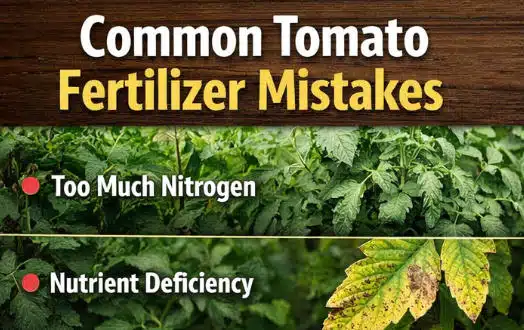
One of the most common mistakes is applying too much nitrogen.
What happens:
- Lush green leaves grow rapidly
- Flowering and fruiting are delayed
- Plants become more susceptible to pests and diseases
This is especially common when growers use a general-purpose fertilizer instead of a balanced fertilizer for tomatoes.
How to fix it:
- Use a balanced NPK ratio during early growth
- Reduce nitrogen once flowering begins
- Switch to a low nitrogen high potassium fertilizer for tomatoes during fruiting
MASL offers tailored nutrient solutions designed to support stage-specific crop needs, helping growers avoid excessive nitrogen application.
2. Ignoring Soil Testing
Many growers apply fertilizer without understanding their soil condition.
Why this is a problem:
- You may add nutrients that already exist in excess
- Key deficiencies remain uncorrected
- Fertilizer efficiency decreases
Best practice:
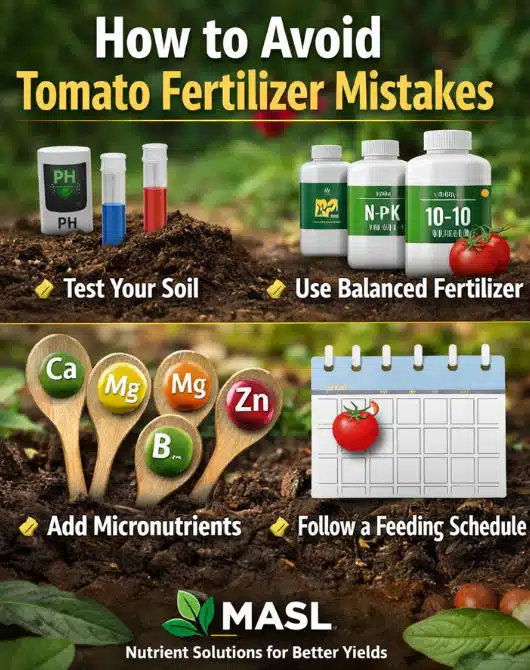
Before choosing a tomato fertilizer program, conduct a soil test to determine:
- pH level
- Nutrient availability
- Organic matter content
This allows for precise fertilization instead of guesswork.
3. Using the Wrong Fertilizer at the Wrong Stage
Tomatoes have different nutritional needs at each growth stage.
Common mistake:
Using the same fertilizer from seedling stage to harvest.
Correct approach:
- Vegetative stage: Higher nitrogen for leaf development
- Flowering stage: Increased phosphorus for bloom support
- Fruiting stage: Higher potassium for fruit quality
Using a tomato fertilizer schedule for maximum yield ensures plants receive the right nutrients at the right time.
4. Overfertilization (More Is Not Better)
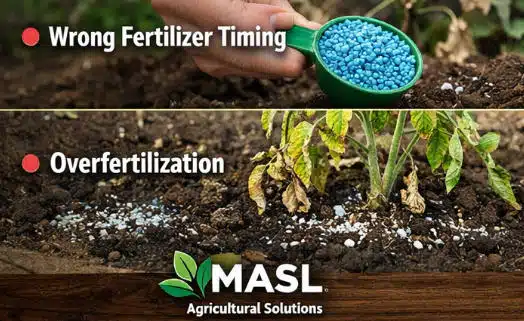
Applying too much fertilizer is just as harmful as applying too little.
Symptoms:
- Leaf burn or yellowing
- Salt buildup in soil
- Reduced root function
This often happens when growers try to accelerate growth using high doses of organic tomato fertilizer or synthetic blends.
Solution:
- Follow recommended application rates
- Apply fertilizer in smaller, controlled doses
- Use slow-release or controlled-release fertilizers when possible
5. Neglecting Micronutrients
Many fertilization programs focus only on NPK and ignore micronutrients.
Important micronutrients for tomatoes:
- Calcium (Ca) – prevents blossom-end rot
- Magnesium (Mg) – supports chlorophyll production
- Zinc (Zn) and Boron (B) – improve flowering and fruit set
Without these, even the best tomato fertilizer for high yield will fall short.
MASL formulations often include essential trace elements to ensure complete plant nutrition.
6. Poor Water-Fertilizer Management
Fertilizer effectiveness depends heavily on irrigation practices.
Common issues:
- Nutrient leaching due to overwatering
- Poor absorption due to underwatering
- Uneven nutrient distribution
Best approach:
- Combine fertilization with proper irrigation (fertigation)
- Maintain consistent soil moisture
- Avoid water stress during flowering and fruiting
This is especially critical when using liquid tomato fertilizer or fertigation systems.
7. Not Adjusting for Soil pH
Soil pH affects nutrient availability.
Problem:
Even if nutrients are present, plants cannot absorb them if pH is incorrect.
Ideal pH for tomatoes:
- Between 6.0 and 6.8
Fix:
- Use lime to raise pH
- Use sulfur to lower pH
- Monitor regularly
Ignoring pH can make even the best fertilizer for tomatoes in raised beds ineffective.
8. Skipping Organic Matter and Soil Health
Fertilizer alone is not enough.
Mistake:
Relying solely on chemical fertilizers without improving soil structure.
Why it matters:
- Poor soil reduces nutrient retention
- Microbial activity declines
- Root growth is restricted
Solution:
- Add compost or organic matter
- Use bio-stimulants or amino acid fertilizers
- Improve soil aeration
MASL’s bio-based solutions can enhance nutrient uptake and soil vitality, complementing traditional fertilization programs.
9. Inconsistent Fertilization Schedule
Irregular feeding leads to inconsistent plant performance.
Results:
- Uneven fruit size
- Blossom drop
- Reduced yield
Recommendation:
Follow a consistent tomato fertilization schedule for beginners and commercial growers:
- Weekly or bi-weekly feeding (depending on method)
- Adjust based on plant growth and environmental conditions
10. Ignoring Plant Signals
Plants often show clear signs of nutrient imbalance.
Examples:
- Yellow leaves → Nitrogen deficiency
- Purple leaves → Phosphorus deficiency
- Brown spots → Calcium deficiency
Failing to respond quickly can reduce yield potential.
Tip:
Regularly inspect plants and adjust your tomato fertilizer program accordingly.
How MASL Helps Optimize Tomato Fertilization
As a professional agricultural solutions provider, MASL focuses on developing high-efficiency fertilizers tailored for crop-specific needs.
On the MASL website, you can find products such as:
- Amino acid fertilizers for stress resistance
- Balanced NPK fertilizers for vegetables
- Bio-stimulants for improved nutrient uptake
These solutions are designed to:
- Reduce fertilizer waste
- Improve nutrient absorption
- Enhance fruit quality and yield
By combining scientific formulation with practical application, MASL helps growers avoid common fertilization mistakes and achieve better results.
Avoiding common tomato fertilizer mistakes is one of the most effective ways to improve both yield and fruit quality. From overusing nitrogen to ignoring micronutrients and soil conditions, small errors can lead to significant losses.
The key is to adopt a balanced, stage-specific, and data-driven fertilization strategy. Whether you’re using organic inputs or advanced nutrient systems, consistency and precision are essential.
By choosing the right tomato fertilizer and following best practices, you can unlock the full potential of your tomato crop.

